The right pressure reducing valve manufacturer depends first on the medium. Steam, natural gas and water each have their own valve designs, and few manufacturers are strong in all three. This guide compares eight pressure reducing valve manufacturers by the models they publish, the size and pressure ranges of those models, and the duty each one suits.
SHINJO is our own brand. It is listed on the same terms as the others, and every figure below comes from the manufacturer's published product data.
| Manufacturer | Media covered here | Representative models | Published range | Typical fit |
|---|---|---|---|---|
| SHINJO (China) | Steam, gas, water | Y43H, RP-1H, RP-6, YK43X, 200X, Y42X | Steam and gas: DN15 to DN500, PN16 to PN160. Water: up to DN800 | Flanged industrial valves for several media from one supplier |
| Spirax Sarco (UK) | Steam | BRV2, DP series, 25 Series | 25 Series: 1/2 in to 4 in, and 6 in | Steam users who source the whole reducing station from one company |
| TLV (Japan) | Steam | COSPECT COS-3, COS-16, COS-21 | Inlet pressure up to 2.1 MPaG | Process heating where wet steam is a concern |
| Emerson (USA) | Natural gas | Fisher 630, Tartarini MF and MN | Fisher 630: inlet up to 103 bar, outlet 0.21 to 34.5 bar | High-pressure industrial gas and burner supply |
| Pietro Fiorentini (Italy) | Natural gas | FE, NeoR, Reflux 819 | FE: inlet up to 7 bar. NeoR: inlet up to 100 psig | Gas distribution networks and service lines |
| Watts (USA) | Water | LF25AUB-Z3, LFF115 | LF25AUB-Z3: 1/2 in to 2 in. LFF115: 1-1/4 in to 8 in | Building water supply |
| Cla-Val (USA) | Water | 90-01 | 1-1/4 in to 36 in | Large water lines that need a pilot-controlled valve |
| BERMAD (Israel) | Water | Model 720 | DN40 to DN600 | Waterworks pressure management |
Each manufacturer in this guide makes self-acting pressure reducing valves or regulators for at least one of the three media, publishes technical data for the models named, and covers a duty the others do not. The order follows the medium and is not a ranking. Most of these companies make far more than the models listed here; the models are examples that show where each manufacturer is strongest.
SHINJO is a China-based pressure reducing valve manufacturer with flanged industrial models for steam, gas and water. Most of the range follows Chinese GB designs, with bodies in cast steel, stainless steel, cast iron or ductile iron.
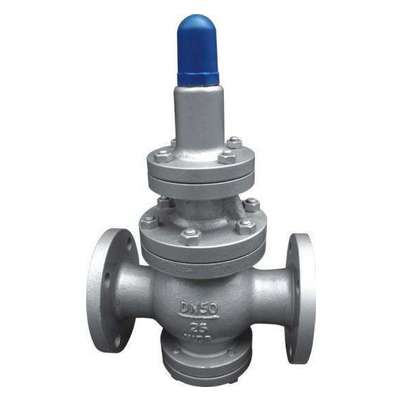
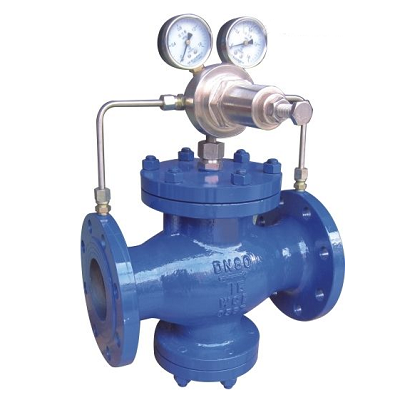
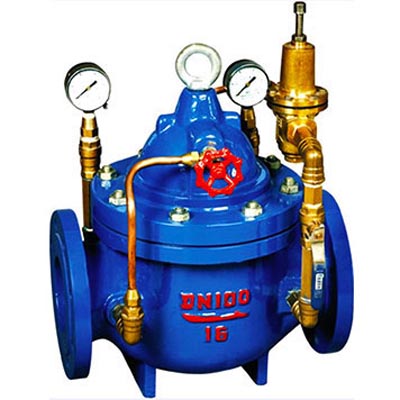
| Model | Medium | Design | Size | Pressure rating | Body material |
|---|---|---|---|---|---|
| Y43H | Steam | Pilot-operated piston | DN15 to DN500 | PN16 to PN160 | WCB, CF8, CF8M |
| RP-1H | Steam | Pilot-operated piston | DN15 to DN500 | PN16 to PN160 | WCB |
| RP-6 | Steam | Pilot-operated piston | DN15 to DN80 | PN10, PN16 | WCB |
| YK43X | Air, nitrogen and other gases | Pilot-operated piston | DN15 to DN500 | PN16 to PN160 | WCB, CF8, CF8M |
| 200X | Water | Pilot-operated, diaphragm or piston type | DN20 to DN800 | PN10, PN16, PN25 | Cast iron, ductile iron |
| Y42X | Water and non-corrosive liquids | Direct-acting diaphragm | DN15 to DN500 | PN10, PN16, PN25 | WCB, cast iron, ductile iron |
| 200P | Building water supply | Direct-acting diaphragm, threaded | DN15 to DN50 | PN10, PN16 | Brass or 304 stainless steel |
The Y43H is the main steam model. A pilot valve senses the outlet pressure and moves the piston that positions the main valve. It is published in six pressure classes from PN16 to PN160. At PN16 the outlet pressure adjusts from 0.1 to 1.0 MPa, and at PN40 from 0.1 to 2.5 MPa. Flow coefficients run from Cv 1 at DN15 to Cv 1,500 at DN500. The RP-1H covers the same classes with a WCB body, and its high-pressure version is listed separately for PN64 to PN160. The RP-6 is the smaller flanged option at PN10 and PN16.
For how these valves work and how to size them, see our steam pressure reducing valve guide and the working principle of a steam pressure reducing valve.
The YK43X uses the same pilot-and-piston design for gas pipelines. SHINJO lists it for air, nitrogen, oxygen, hydrogen, liquefied gas and natural gas, and states zero leakage for the soft-seat version. For water, the 200X is a pilot-operated hydraulic control valve for mains and plant supply, the Y42X is a direct-acting flanged valve, and the 200P is a threaded brass valve for branch lines in buildings, rated from -9 to 80 °C. For duties that need a self-operated regulator, the ZZYP series is listed in PN16 to PN64 and Class 150 to 300; its operation is explained in how the ZZYP pressure regulator works.
SHINJO suits buyers who need flanged industrial valves for more than one medium from a single supplier, or pressure classes up to PN160. Because the designs follow GB standards, confirm the flange standard, the face-to-face dimension and the test standard when you request a quotation. Where a specification calls for a potable-water listing or a gas-utility regulator with an integrated slam-shut device, the specialists below are the more direct fit.
Need a valve sized for your system? Send your medium, inlet pressure range, required outlet pressure, temperature, minimum and maximum flow, and connection standard to SHINJO to discuss a suitable model.
Alongside SHINJO's Y43H, RP-1H and RP-6, two steam specialists are worth comparing.
Spirax Sarco, based in the UK, lists both designs in its pressure reducing valve range. The BRV2 is a direct-acting valve with an SG iron body, a compact choice where some variation in downstream pressure is acceptable. The DP series and the 25 Series are pilot-operated, for loads that change and need closer pressure control. The 25 Series is listed in sizes from 1/2 in to 4 in, and in 6 in.
Spirax Sarco also supplies the other components of a steam pressure reducing station, which matters to buyers who want the whole installation from one company.
TLV, based in Japan, builds a strainer, a cyclone separator and a Free Float steam trap into its COSPECT pressure reducing valve. The separator removes entrained condensate, the trap discharges it, and the strainer catches scale and rust.
Three models are listed: the COS-3 for inlet pressures up to 0.3 MPaG, the COS-16 up to 1.6 MPaG and the COS-21 up to 2.1 MPaG. COSPECT fits process heating equipment where wet steam and debris are a concern.
In gas service, pressure reducing valves are usually called regulators. Regulators for gas distribution often include safety devices such as a slam-shut valve, so this is specialist territory. For industrial gases in plant pipework, such as compressed air and nitrogen, SHINJO's YK43X is the comparable model.
Emerson, based in the USA, owns both brands. The Fisher 630 is a direct-operated, spring-loaded regulator in NPS 1 and NPS 2, with inlet pressures up to 103 bar (1,500 psi) and outlet settings from 0.21 to 34.5 bar (3 to 500 psi). Emerson lists it for first-stage farm-tap service and high-pressure industrial regulation.
The Tartarini MF and MN series are spring-loaded regulators for duties where demand changes suddenly or the gas is shut off by a solenoid valve, as on domestic and industrial burners. Slam-shut devices are optional.
Pietro Fiorentini, based in Italy, focuses on gas networks. The FE is a two-stage, direct-operated regulator for low-pressure distribution to residential and commercial users, with a maximum inlet pressure of 7 bar and an integrated slam-shut device. The NeoR is a two-stage service regulator for inlet pressures up to 100 psig, with an internal relief valve and no slam-shut device.
For higher pressures, the company lists pilot-operated regulators such as the Reflux 819.
Water pressure reducing valves fall into two groups: small direct-acting valves for building supply, and large pilot-controlled valves for mains and plant water. SHINJO's 200P and Y42X belong to the first group and the 200X to the second.
Watts, based in the USA, is best known for building water supply. The lead-free LF25AUB-Z3 comes in sizes from 1/2 in to 2 in, for working pressures up to 300 psi, with the reduced pressure adjustable from 25 to 75 psi and a maximum temperature of 180 °F (82 °C).
For larger lines, the LFF115 is a pilot-operated control valve with a ductile iron body, in sizes from 1-1/4 in to 8 in.
Cla-Val, based in the USA, makes the 90-01, a hydraulically operated, diaphragm-actuated valve in globe or angle pattern, controlled by a pilot. It is listed in sizes from 1-1/4 in to 36 in, with a ductile iron body and bronze trim as standard. The pilot is supplied in several adjustment ranges, from 2 to 6.5 psi at the low end up to 30 to 300 psi.
BERMAD, based in Israel, lists the Model 720 in its 700 Series for waterworks. It is a hydraulically operated control valve with a double-chamber actuator and a ductile iron body, in sizes from DN40 to DN600 and pressure ratings of 250 and 400 psi. BERMAD presents it for pressure management and leakage control in distribution networks.
Regulators mounted on machines, such as the SMC AR series and the Festo MS series, are part of air preparation units. They are sized for individual actuators and tools, and they are a different product from the pipeline valves in this guide. For compressed air or nitrogen in plant pipework at flanged sizes, a piston-type gas pressure reducing valve such as the YK43X is the comparable product.
Whichever manufacturer you choose, this is the first design decision, and it applies to every medium.
The minimum pressure difference is a published figure. The SHINJO RP-1H, for example, needs at least 0.07 MPa across the valve at PN16.
Which pressure reducing valve suppliers can meet your actual operating conditions? Send each supplier the same specifications so you can compare suitable products and quotations.
| Selection factor | What to confirm |
|---|---|
| Medium | Specify steam, natural gas, compressed air or water, including any contaminants that affect material selection. |
| Inlet and outlet pressure | Provide minimum, normal and maximum inlet pressures, plus the required outlet pressure and acceptable variation. |
| Temperature | State the operating temperature range so the supplier can check body, seat and seal suitability. |
| Flow rate | Provide minimum, normal and maximum flow with units. Pipe diameter alone is insufficient for valve sizing. |
| Materials | Confirm body, trim and seal compatibility with the medium and operating conditions. |
| Connections | Specify pipe size, threaded or flanged connections, and the required connection standard and pressure rating. |
| Delivery requirements | Confirm quantity, destination, required delivery date, documentation and spare-parts availability. |
Ask the supplier to identify the proposed model, explain its sizing basis and provide the relevant technical datasheet. A quotation becomes more useful when it shows how the valve meets your requirements, rather than listing only a size and price.
| Your system | Manufacturers and models to compare |
|---|---|
| Steam in flanged industrial lines | SHINJO Y43H or RP-1H, to DN500 and PN160; Spirax Sarco DP series or 25 Series |
| Steam to process heating equipment, with wet steam a concern | TLV COSPECT |
| High-pressure natural gas, first-stage reduction | Emerson Fisher 630 |
| Gas distribution networks and service lines | Pietro Fiorentini FE, NeoR or Reflux 819 |
| Gas supply to burners | Emerson Tartarini MF and MN |
| Compressed air, nitrogen and other gases in plant pipework | SHINJO YK43X |
| Building water supply up to 2 in | Watts LF25AUB-Z3; SHINJO 200P |
| Water mains and large plant lines | Cla-Val 90-01; BERMAD 720; Watts LFF115; SHINJO 200X |
The best choice depends on your medium and operating conditions. Compare pressure reducing valve brands by their suitable models, flow capacity, pressure-control performance and technical support. A familiar brand name alone does not establish suitability for your system.
Choose a direct-acting valve for small lines and steady loads, where some fall in outlet pressure at high flow is acceptable. Choose a pilot-operated valve when the flow varies widely, the line is large, or the outlet pressure must stay close to the set point.
A pressure reducing valve is a type of regulator that controls downstream pressure. "Pressure regulator" is commonly used in gas and compressed-air applications, but the term also covers back-pressure regulators, which control upstream pressure.
A pressure reducing valve regulates downstream pressure during normal operation. A pressure relief valve discharges fluid when pressure reaches its set threshold. They serve different purposes, and a reducing valve cannot replace a required overpressure protection device.
A pressure reducing valve works without external power or a control signal, and its set point is adjusted by hand at the valve. Use an actuated control valve when the set point has to be changed remotely, or when the valve must work as part of a control loop with a transmitter and controller. Our pneumatic control valve guide covers that type.
A manufacturer produces valves, while a supplier may be a manufacturer, distributor or reseller. Before ordering, confirm who manufactures the proposed valve, who provides technical support, and who handles warranty claims and spare parts.
