A forged steel gate valve for small-bore piping is normally specified to API 602, whose current eleventh edition covers NPS 1/4 to 4 (DN 8 to 100) in Class 150, 300, 600, 800 and 1500. In the tenth edition's scope, the size limit depends on the configuration: socket-weld and threaded ends stop at NPS 2 1/2 (DN 65) and come only in Class 800 and Class 1500, and flanged Class 800 is excluded. Class 800 is an intermediate class, not a listed ASME B16.34 class. For forged A105 and A350 LF2, Emerson's ASME B16.34 bulletin prints 136.2 bar (1975 psig) at -29 to 38 °C (-20 to 100 °F). Name the API 602 edition, the configuration, the class, the end standard, the body grade, the trim number and the test standards on the datasheet.
A small-bore forged steel gate valve is usually specified to API 602, whose tenth-edition scope limits size and class by configuration. In that scope, socket-weld and threaded ends stop at NPS 2 1/2 (DN 65) and come only in Class 800 and Class 1500. Class 800 with flanged ends is excluded. Buyers confirm each limit against the current eleventh edition. Class 800 is an intermediate class, not a listed ASME B16.34 class. Emerson's ASME B16.34 bulletin prints 136.2 bar (1975 psig) for Class 800 in forged A105 and A350 LF2 at -29 to 38 °C (-20 to 100 °F).
This guide is for procurement and project engineers writing line lists or RFQs for small-bore forged gate valves in refinery, petrochemical, oil and gas or utility piping. They choose forged or cast bodies, the API 602 configuration and Class 800 or Class 1500. They check ends against ASME B31.3, including the socket-weld gap, and specify the bonnet and backseat. Body grades include A105, A350 LF2, F11, F22, F304, F316 and F51. Trims include API Trim 5, 8, 12 and 16. The order names API 598, API 622 and API 624 tests, plus NACE MR0175 / ISO 15156 for sour service.
- API 602's tenth edition limits size by configuration. Socket-weld, threaded and ISRS valves stop below the OS&Y flanged size ceiling.
- Class 800 is an intermediate class. Its ratings are linearly interpolated between ASME B16.34 Class 600 and Class 900 ratings.
- API 602's tenth edition excludes flanged Class 800. Order Class 800 with socket-weld, threaded or butt-weld ends.
- Forging does not raise the printed rating. At ambient, Emerson prints one Class 800 value for WCB and A105.
- Write the trim number with its materials. Trim 8 pairs a 13Cr wedge with a CoCr-hardfaced seat.
- Name each test standard and edition. API 598 pressure tests; API 622 packing and API 624 valve type tests.
- Sour service is a requirement set. Name NACE MR0175, or MR0103 for refineries, and ask for hardness records.
- TL;DR
- Abstract
- Key Takeaways
- Forged Steel Gate Valve: What It Is and How It Differs From a Cast Valve
- Glossary
- API 602 Gate Valve Scope: Sizes, Classes and Configurations
- Gate Valve Class 800: Where the Rating Comes From
- End Connections: Socket Weld, Threaded, Butt Weld and Flanged
- Bonnet, Stem and Backseat on a Forged Gate Valve
- Forged Body Materials by Service: A105, A350 LF2, F11, F22 and F51
- API Trim Numbers 5 and 8 for Forged Gate Valves
- Testing and Emissions: API 598, API 622 and API 624
- Forged Steel Gate Valve RFQ Checklist
- Frequently Asked Questions
- Conclusion
- References
A forged steel gate valve is a compact gate valve whose body and bonnet are steel forgings, such as ASTM A105 or A350 LF2, not castings such as A216 WCB (Emerson, 2017). It is usually specified to API 602, whose current eleventh edition covers NPS 4 (DN 100) and smaller (American Petroleum Institute, 2022).
If the valve type is not yet chosen, start with the gate valve vs ball valve comparison.
For the grades in this table, grade and product form change; the printed rating does not.
| Datasheet item | Cast body | Forged body |
|---|---|---|
| Product form in Emerson's ASME B16.34 bulletin | cast materials (Emerson, 2017) | forged materials (Emerson, 2017) |
| Group 1.1 grade | A216 WCB (WerMac, n.d.) | A105, A350 LF2 (WerMac, n.d.) |
| Printed Class 800 rating, -29 to 38 °C (-20 to 100 °F) | 136.2 bar (1975 psig) (Emerson, 2017) | 136.2 bar (1975 psig) (Emerson, 2017) |
| Listed in API 602's tenth edition | casting descriptions, Tables 1a to 1c (American Petroleum Institute, 2015) | forging descriptions, Tables 1a to 1c (American Petroleum Institute, 2015) |
For WCB against A105 or A350 LF2, forging changes the product form, not the ASME B16.34 material group or its printed rating; other cast and forged pairs can sit in different groups. API 602's tenth edition lists castings too, so a buyer who needs a forging writes "forged" and the ASTM forging grade on the datasheet. A casting is poured into a mold; a forging is shaped from solid steel.
A study of open-die forging of large steel ingots notes that as-cast voids may significantly affect the final product's mechanical properties (Harris et al., 2016). Its simulation found upsetting most effective for closing voids in core regions (Harris et al., 2016). It did not study a valve body, so it does not show that a forged valve body is stronger than a casting.
Bonney Forge's catalog describes its gate valve body and bonnet as forged steel, the body designed to the basic dimensional requirements of specifications such as API 602 and ASME B16.34 (Bonney Forge, n.d.).
A forged steel gate valve is a compact gate valve whose body and bonnet are steel forgings, such as A105, A350 LF2 or an ASTM A182 grade, rather than castings such as A216 WCB (Emerson, 2017), usually specified to API 602 for NPS 4 (DN 100) and smaller (American Petroleum Institute, 2022). Emerson's ASME B16.34 bulletin gives cast WCB and forged A105 and A350 LF2 the same Class 800 rating, 136.2 bar (1975 psig) at -29 to 38 °C (-20 to 100 °F) (Emerson, 2017).
- Compact valve: API 602's gate, globe or check valve of NPS 4 (DN 100) and smaller (American Petroleum Institute, 2022).
- OS&Y: outside screw and yoke; the tenth edition's scope names it outside screw with rising stems (American Petroleum Institute, 2015).
- ISRS: inside screw with rising stems, the tenth edition's other stem design (American Petroleum Institute, 2015).
- Extended body: a body with a threaded or welding end extension, as the figure titles in the tenth edition's Annex B show (American Petroleum Institute, 2015).
- Standard bore and full bore: the tenth edition's body seat openings, each with a minimum flow passageway table (American Petroleum Institute, 2015).
An API 602 gate valve is a compact gate valve of NPS 4 (DN 100) and smaller in Class 150, 300, 600, 800 or 1500 (American Petroleum Institute, 2022). Within that range, the tenth edition's scope gives each configuration its own size and class limits (American Petroleum Institute, 2015).
API 602's current edition is the Eleventh Edition, published in May 2022; Accuris lists the Tenth Edition as a historical version (American Petroleum Institute, 2022). The eleventh edition covers NPS 1/4 to 4 (DN 8 to 100) and pressure class designations 150, 300, 600, 800 and 1500 (American Petroleum Institute, 2022). Write the edition on the purchase order.
API's product page for the tenth edition (May 2015) sets size and class limits by configuration (American Petroleum Institute, 2015).
| Configuration | Sizes, NPS (DN) | Pressure designations | Note |
|---|---|---|---|
| OS&Y | NPS 1/4 to 4 (DN 8 to 100) | including Class 800 | outside screw, rising stem |
| ISRS | NPS 1/4 to 2 1/2 (DN 8 to 65) | Class 800 and below | inside screw, rising stem |
| Socket-welding or threaded ends | NPS 1/4 to 2 1/2 (DN 8 to 65) | Class 800 and Class 1500 | ends |
| Flanged or butt-welding ends | NPS 1/2 to 4 (DN 15 to 100) | Class 150 through Class 1500 | excluding flanged-end Class 800 |
| Extended body | NPS 1/2 to 2 (DN 15 to 50) | Class 800 and Class 1500 | body |
| Bellows stem seal | NPS 1/4 to 2 (DN 8 to 50) | below Class 1500 | stem seal |
| Bonnet joint: bolted, welded, or threaded with seal weld | no size limit stated | up to Class 1500 | bonnet |
| Bonnet joint: union nut | no size limit stated | Class 800 and below | bonnet |
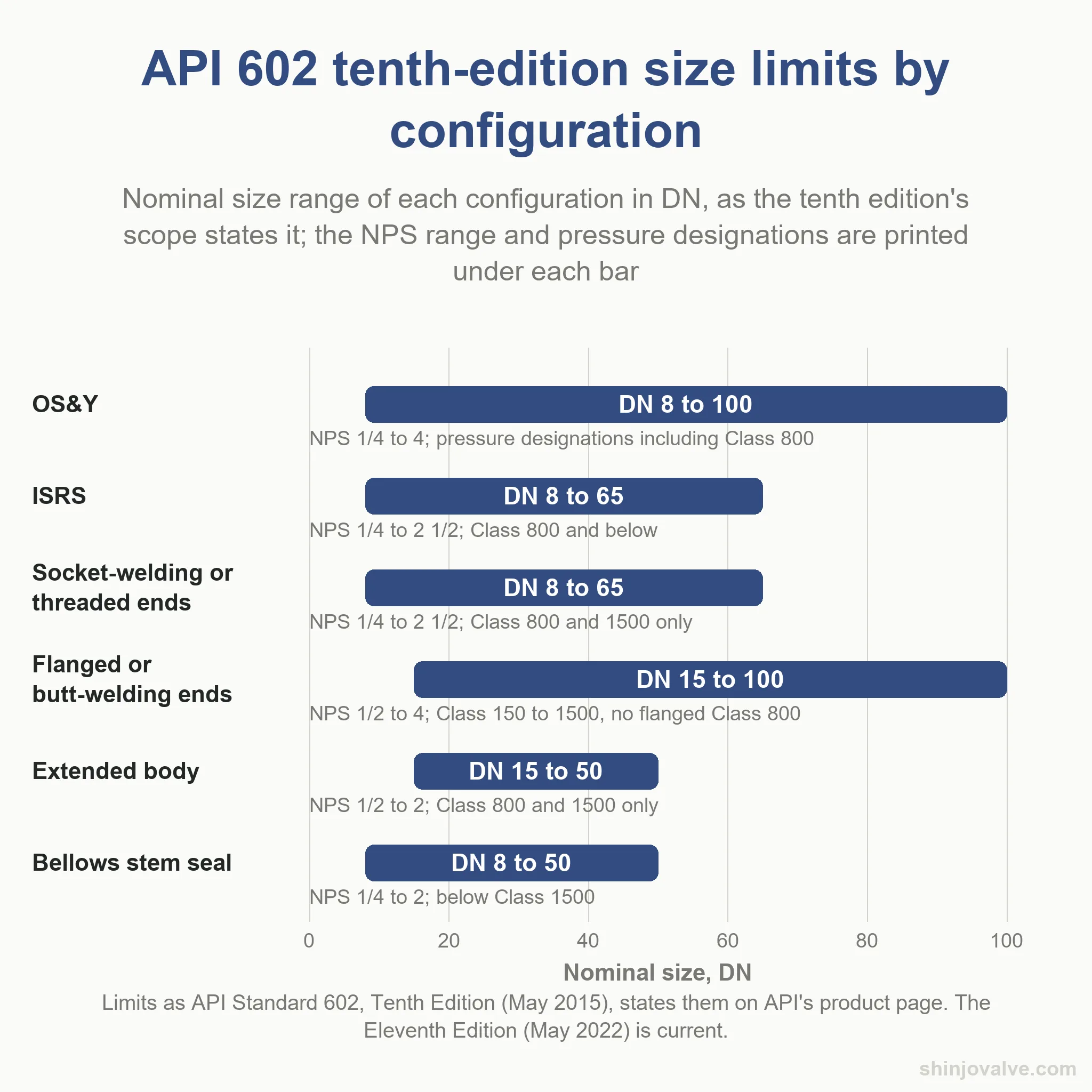
Taken together, the scope limits confine the NPS 4 (DN 100) ceiling to OS&Y valves with flanged or butt-welding ends. Socket-weld, threaded and ISRS valves stop at NPS 2 1/2 (DN 65), and extended-body valves at NPS 2 (DN 50). Class 150, 300 and 600 appear only with flanged or butt-welding ends, because socket-weld and threaded ends are listed only for Class 800 and Class 1500. These limits are the tenth edition's; confirm each against the eleventh edition in force.
Walworth's API 602 catalog lists its gate valves in NPS 1/4 to 2, with socket-weld or NPT ends in Class 800, 1500 and 2500 and RF or RTJ flanged ends in Class 150, 300, 600 and 1500 (Walworth, n.d.); Class 2500 is outside API 602's designations. Bonney Forge's 800 lb gate valve dimension tables reach NPS 3 in one figure and stop at NPS 2 in the others (Bonney Forge, n.d.). A maker's line can be narrower than the standard, so the datasheet names stem type, end connection, body type and bore, not only "API 602".
The tenth edition's scope provides for standard and full-bore body seat openings (American Petroleum Institute, 2015). The gate valves Shinjo supplies are specified on the same datasheet lines.
In API 602's tenth edition, OS&Y valves run NPS 1/4 to 4 (DN 8 to 100). Socket-welding or threaded ends and ISRS stems stop at NPS 2 1/2 (DN 65). Flanged or butt-welding ends run NPS 1/2 to 4 (DN 15 to 100). Extended bodies stop at NPS 2 (DN 50) (American Petroleum Institute, 2015). Confirm each against the eleventh edition in force.
Class 800 is an intermediate class, not a listed class designation, widely used for compact socket-weld and threaded valves (American Petroleum Institute, 2015). For forged A105 and A350 LF2, Emerson's ASME B16.34 bulletin prints 136.2 bar (1975 psig) at -29 to 38 °C (-20 to 100 °F) (Emerson, 2017).
Per API's product page for the tenth edition, "Class 800 is not a listed class designation, but is an intermediate class number widely used for socket welding and threaded end compact valves." (American Petroleum Institute, 2015)
The tenth edition prints its own Class 800 rating tables, Tables 2a to 2f; its product page shows no values (American Petroleum Institute, 2015). WerMac explains that API 602 and ISO 15761 derive Class 800 by linear interpolation: one third of the ASME B16.34 Class 600 rating plus two thirds of the Class 900 rating, including above 38 °C (100 °F) (WerMac, n.d.).
API 602 is the valve's design standard and ASME B16.34 its rating standard; the difference between API and ASME standards affects every line of the order. A line item reading "gate valve class 800, socket weld, A105" is not yet a specification.
Emerson's bulletin prints these ASME B16.34 ratings for forged A105 and A350 LF2 (Emerson, 2017); the end connections follow the tenth edition's scope (American Petroleum Institute, 2015).
| Class | Status | Rating at -29 to 38 °C (-20 to 100 °F), bar (psig) | End connections in the tenth edition's scope |
|---|---|---|---|
| Class 150 | listed ASME B16.34 class | 19.6 (285) | flanged or butt-welding |
| Class 300 | listed ASME B16.34 class | 51.1 (740) | flanged or butt-welding |
| Class 600 | listed ASME B16.34 class | 102.1 (1480) | flanged or butt-welding |
| Class 800 | intermediate class (API) | 136.2 (1975) | socket-welding, threaded or butt-welding; never flanged |
| Class 900 | listed ASME B16.34 class | 153.2 (2220) | not an API 602 designation |
| Class 1500 | listed ASME B16.34 class | 255.3 (3705) | socket-welding, threaded, flanged or butt-welding |

Bonney Forge's catalog prints the same 1975 psig and 3705 psig for carbon steel Class 800 and Class 1500 at 38 °C (100 °F) (Bonney Forge, n.d.). It also prints Standard, Special and Limited Class rating tables, rates flanged-end valves Standard Class only and applies Limited Class ratings to weld-end and thread-end valves only (Bonney Forge, n.d.). A catalog Class 800 figure must name its basis.
Emerson adds that its tables must be used in accordance with the ASME standard, and that a governing code, such as the ASME Code for Pressure Piping, can add maximum-temperature and low-temperature limits (Emerson, 2017).
A line needs Class 1500 when its design pressure at the design temperature exceeds the Class 800 rating for the body's material group. Emerson's tables show the ratings falling as temperature rises (Emerson, 2017), so above ambient that rating is read from the Class 800 table of the API 602 edition in force. The higher class comes with a trade-off. Under the tenth edition's scope, moving to Class 1500 also removes ISRS stems, union-nut bonnets and bellows stem seals from the options (American Petroleum Institute, 2015); the buyer confirms these exclusions against the eleventh edition.
API's product page for API 602's tenth edition calls Class 800 an intermediate class, not a listed class designation, widely used for socket-welding and threaded compact valves (American Petroleum Institute, 2015). For forged A105 and A350 LF2, Emerson's ASME B16.34 bulletin prints 136.2 bar (1975 psig) at -29 to 38 °C (-20 to 100 °F) (Emerson, 2017).
Every gate valve decision in this guide, from the API 602 edition down to the trim number, ends up as one line on a datasheet, and each line narrows which configuration actually fits the job. Shinjo’s gate valve range is where those lines get checked against a real listing, for procurement and project engineers specifying against a datasheet or line list.
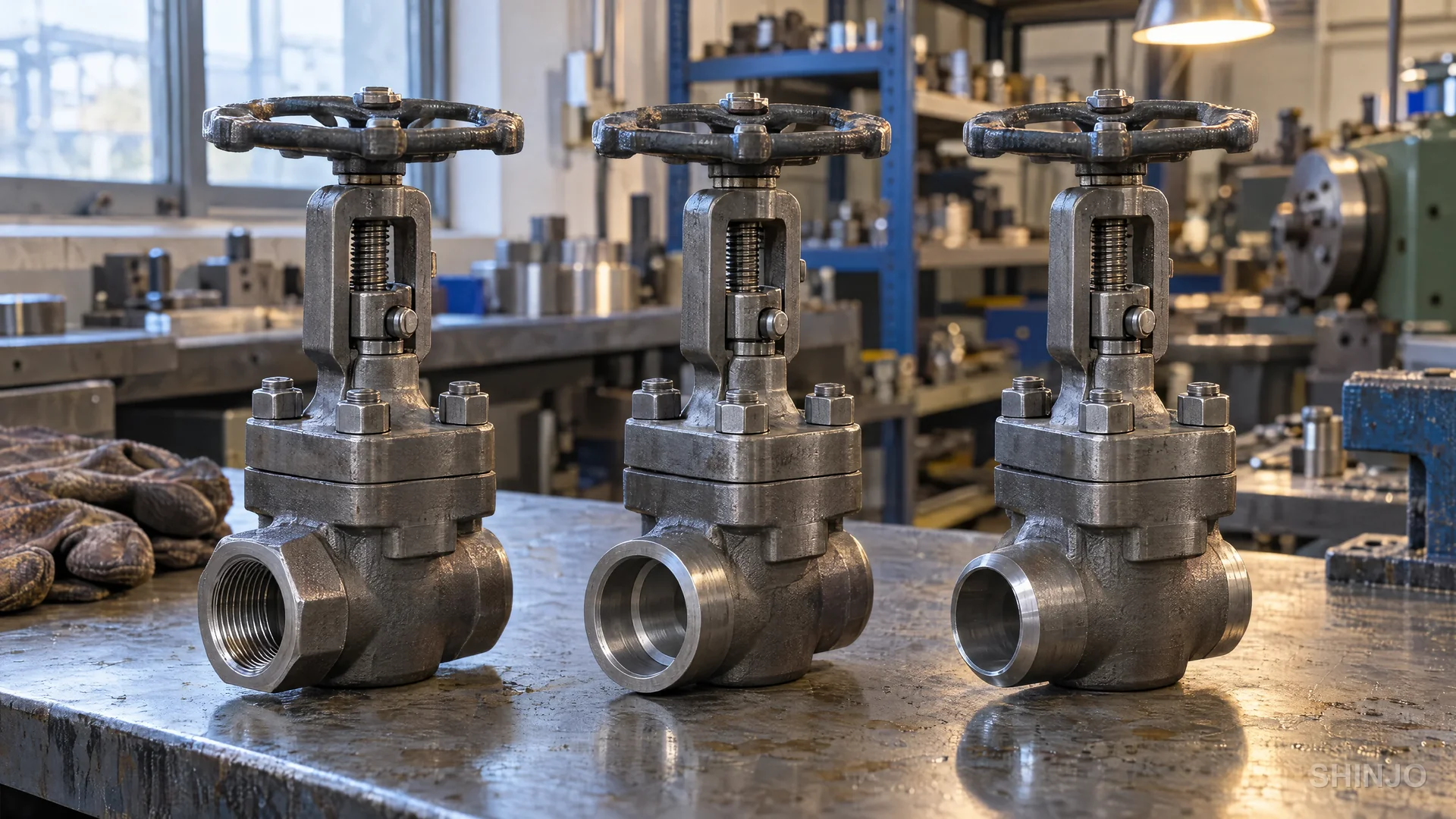
A forged steel gate valve's end connection sets its API 602 size and class range and decides where the piping code accepts the joint. The tenth edition of API 602 ties each end to a standard (American Petroleum Institute, 2015), and so does Bonney Forge's catalog (Bonney Forge, n.d.). The datasheet names the end and its standard.
Size and class limits quote the tenth edition's scope; confirm each against the eleventh edition in force.
| End connection | Dimensional standard | Sizes and classes (tenth edition's scope) | ASME B31.3 caution | Datasheet line |
|---|---|---|---|---|
| Socket weld | ASME B16.11 (American Petroleum Institute, 2015) | NPS 1/4 to 2 1/2 (DN 8 to 65); Class 800 and Class 1500 (American Petroleum Institute, 2015) | avoid where crevice corrosion or severe erosion may occur; not larger than NPS 2 (DN 50) under severe cyclic conditions (American Society of Mechanical Engineers, 2018) | socket weld to ASME B16.11; gap in weld procedure |
| Threaded (NPT) | ASME B1.20.1 (American Petroleum Institute, 2015) | NPS 1/4 to 2 1/2 (DN 8 to 65); Class 800 and Class 1500 (American Petroleum Institute, 2015) | avoid where crevice corrosion, severe erosion or cyclic loading may occur (American Society of Mechanical Engineers, 2018) | NPT to ASME B1.20.1; seal welded or not |
| Butt weld | the tenth edition's own requirements (American Petroleum Institute, 2015); ASME B16.25 in catalogs (Bonney Forge, n.d.) | NPS 1/2 to 4 (DN 15 to 100); Class 150 through Class 1500 (American Petroleum Institute, 2015) | weld procedure preserves seat tightness (American Society of Mechanical Engineers, 2018) | butt weld; weld procedure and heat treatment |
| Flanged | ASME B16.5 (American Petroleum Institute, 2015) | NPS 1/2 to 4 (DN 15 to 100); Class 150 through Class 1500, never Class 800 (American Petroleum Institute, 2015) | not addressed by paras. 311.2.2 or 314.1 | ASME B16.5 flange, RF or RTJ facing (Walworth, n.d.) |
ASME B31.3 (2018 edition) para. 314.1(a) says threaded joints should be avoided where crevice corrosion, severe erosion or cyclic loading may occur (American Society of Mechanical Engineers, 2018). Para. 314.1(b) allows no thread sealing compound on a threaded joint to be seal welded (American Society of Mechanical Engineers, 2018).
Para. 311.2.2(a) gives socket welded joints the same caution for crevice corrosion or severe erosion (American Society of Mechanical Engineers, 2018). Para. 311.2.2(c) bars socket welds larger than NPS 2 (DN 50) under severe cyclic conditions (American Society of Mechanical Engineers, 2018).
The tenth edition's scope excludes flanged Class 800 (American Petroleum Institute, 2015). Read with paras. 314.1(a) and 311.2.2(a), butt weld is the Class 800 end that avoids both cautions in crevice-corrosion or severe-erosion service.
ASME B31.3 Figure 328.5.2C sets minimum welding dimensions for socket welding components other than flanges, including a gap before welding (American Society of Mechanical Engineers, 2018).
Para. 328.5.1(f) of ASME B31.3 requires the welding sequence, procedure and any heat treatment of a welding end valve to preserve its seat tightness (American Society of Mechanical Engineers, 2018). Per Walworth's API 602 catalog, gate valves install in either flow direction but are not for flow modulation, which may erode the wedge and seats (Walworth, n.d.).
Warning: A pipe pushed to the bottom of the socket leaves no gap, so the weld procedure states the gap and the fit-up is checked before the first tack weld.
ASME B31.3 Figure 328.5.2C shows a gap of approximately 1.5 mm (1/16 in.) between the pipe end and the socket bottom before welding (American Society of Mechanical Engineers, 2018). For a socket-weld gate valve, the weld procedure states that gap, so the fit-up is checked against a written figure before the pipe is welded into the socket.
The tenth edition of API 602 lists bolted, welded, threaded-and-seal-welded and union-nut bonnet joints, plus two rising-stem constructions: outside screw and yoke (OS&Y) and inside screw with rising stem (ISRS) (American Petroleum Institute, 2015). The backseat is a seat in the bonnet that a shoulder on the stem mates with (Bonney Forge, n.d.). Seated, it relieves back pressure on the stem packing (Walworth, n.d.).
Each bonnet joint has its own class limit.
| Bonnet or stem seal | Tenth edition's scope | Seal element in the catalogs | Datasheet line |
|---|---|---|---|
| Bolted bonnet | up to Class 1500 (American Petroleum Institute, 2015) | spiral-wound or oval ring joint gasket (Bonney Forge, n.d.) | bolted bonnet, gasket type |
| Welded bonnet | up to Class 1500 (American Petroleum Institute, 2015) | body-bonnet weld to ASME Section IX (Bonney Forge, n.d.) | welded bonnet, weld qualification |
| Threaded bonnet with seal weld | up to Class 1500 (American Petroleum Institute, 2015) | threaded and seal welded (Bonney Forge, n.d.) | threaded, seal-welded bonnet |
| Union-nut bonnet | Class 800 and below (American Petroleum Institute, 2015) | not in these catalogs | union-nut bonnet |
| Pressure-seal bonnet | not listed (American Petroleum Institute, 2015) | body-bonnet pressure seal design, listed as a special feature (Bonney Forge, n.d.) | its design standard |
| Bellows stem seal | NPS 1/4 to 2 (DN 8 to 50), below Class 1500 (American Petroleum Institute, 2015) | bellows, Annex D type test (tenth edition) (American Petroleum Institute, 2015) | bellows seal, type-test report |
Shinjo supplies bolted-bonnet forged gate valves; Shinjo's forged bolted-bonnet gate valve page shows one.
Bonney Forge lists a body-bonnet pressure seal design among its special features (Bonney Forge, n.d.). The tenth edition's scope lists no pressure-seal joint, so the datasheet should name the valve's design standard. Shinjo's forged pressure-seal gate valve page shows a pressure-seal bonnet.
Bonney Forge describes its forged steel gate valves as OS&Y, with a rising stem, a non-rising handwheel and an integral backseat (Bonney Forge, n.d.). API 598's test table, as Wolseley Industrial reproduces it, requires a backseat test for gate and globe valves (Wolseley Industrial, n.d.). Operator data for a class and size comes as a torque chart for metal-seated gate valves.
A gate valve backseat seals the stem to the bonnet. On Bonney Forge's forged valves, an integral back seat shoulder on the stem mates with an integral backseat in the bonnet (Bonney Forge, n.d.). When fully seated, the backseat relieves back pressure on the stem packing, but Walworth does not recommend replacing packing under pressure (Walworth, n.d.).
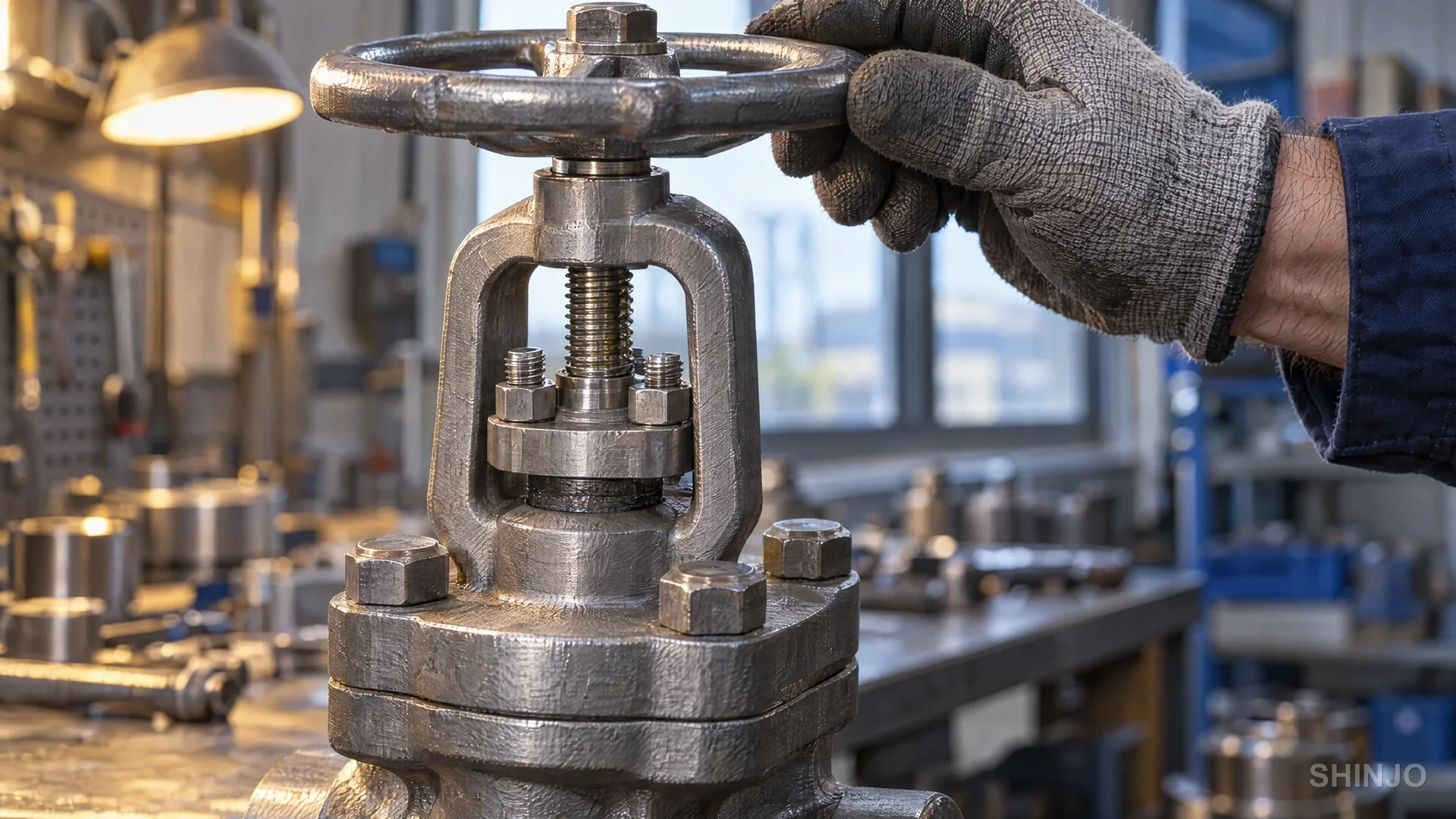
Choose the body grade by design temperature and service. A105 suits general carbon-steel service; A350 LF2 suits low temperatures needing impact-tested steel. F11 or F22 suits higher temperatures, and stainless or duplex grades suit corrosive media. Sour service adds requirements to any grade.
Wolseley Industrial's valve materials chart lists A105 as the carbon steel forging, with a temperature range of -29 to 427 °C (-20 to 800 °F) (Wolseley Industrial, n.d.). Emerson's ASME B16.34 bulletin rates forged valves in columns headed "A105 & A350-LF2", F5, F11, F22, F304, F316, F304L and F316L (Emerson, 2017).
WerMac's reproduction of ASME B16.34 Table 2-1.1 footnotes A105, A216 WCB and A350 LF2: prolonged exposure above 425 °C (797 °F) may convert the carbide phase of the steel to graphite, which is permissible but not recommended for prolonged use (WerMac, n.d.). Bonney Forge's catalog also lists A105N (Bonney Forge, n.d.).
ASTM A350 covers carbon and low-alloy steel forgings, including valves, intended primarily for low-temperature service and requiring notch toughness testing (ASTM International, 2026a). Its impact tests set a minimum impact energy at a test temperature (ASTM International, 2026a). Emerson's bulletin adds that a valve used under an ASME code is subject to its low-temperature material rules (Emerson, 2017).
The datasheet names the minimum design metal temperature (MDMT) and asks for the impact test report.
ASTM A182 covers alloy and stainless forgings, including valves, for high-temperature service (ASTM International, 2026b).
| Grade | ASTM specification | Source notes | Datasheet line |
|---|---|---|---|
| A105 or A105N | ASTM A105 | carbon steel, -29 to 427 °C (-20 to 800 °F) (Wolseley Industrial, n.d.); graphitization above 425 °C (797 °F) (WerMac, n.d.) | grade, design temperature |
| A350 LF2 | ASTM A350 (ASTM International, 2026a) | notch toughness (impact) tested (ASTM International, 2026a) | MDMT, impact test report |
| F11 and F22 | ASTM A182 (ASTM International, 2026b) | Emerson's forged columns (Emerson, 2017); Bonney Forge pairs F11 with Trim 8 or 5 (Bonney Forge, n.d.) | grade, design temperature |
| F304 and F316 | ASTM A182 (ASTM International, 2026b) | Emerson's forged columns and rating charts (Emerson, 2017) | grade against the medium |
| F51 | ASTM A182, 22Cr duplex stainless (Wolseley Industrial, n.d.) | F51 and F53 in Bonney Forge's materials menu (Bonney Forge, n.d.) | grade against the medium |
F304 and F316 appear in Emerson's forged columns (Emerson, 2017) and Bonney Forge's materials menu (Bonney Forge, n.d.). Choosing between them is a corrosion decision the datasheet settles against the medium.
Shinjo supplies extended-body forged gate valves, and Shinjo's extended-body gate valve page lists body types A105, A182 F22, A182 F304(L) and A182 F316(L).
NACE MR0175 / ISO 15156 covers materials for use in H2S-containing environments in oil and gas production, and its Part 1 sets the general principles and the material selection and qualification procedures (SSM Alloys, n.d.). For refining, NACE MR0103 / ISO 17945 covers metallic materials resistant to sulfide stress cracking in corrosive petroleum refining environments, so a refinery line names whichever of the two its plant specification calls up. Per SSM Alloys, NACE MR0175 applies only to sour (H2S-containing) service; in sweet service, A105 needs no NACE compliance (SSM Alloys, n.d.). Its Part 2 covers carbon and low-alloy steels, with a typical maximum hardness of 22 HRC (250 HV) (SSM Alloys, n.d.).
SSM Alloys says the mill test certificate should include hardness test results, a chemical composition report and a heat treatment record, plus hydrogen-induced cracking (HIC) and sulfide stress cracking (SSC) test results where applicable (SSM Alloys, n.d.). Walworth's API 602 catalog lists NACE MR0175 or MR0103 service among its features (Walworth, n.d.). Wolseley Industrial's bolting chart, which carries NACE MR0175 and MR0103 columns, lists A193 B7M bolts with A194 Grade 2HM nuts, beside B7 with 2H, for A105 and WCB bodies (Wolseley Industrial, n.d.). Global Supply Line's trim chart pairs specially treated 316 or 410 trim with B7M bolts and 2HM nuts to meet NACE MR0175 requirements (Global Supply Line, 2023).
Sour service is therefore a requirement set, not a grade. The datasheet states H2S-containing service and the standard the plant specification calls up, NACE MR0175 / ISO 15156 or NACE MR0103 / ISO 17945, with its edition. It asks for hardness and heat-treatment records for body, bonnet and trim, and names the NACE-listed bolting for the body grade, such as B7M bolts with 2HM nuts on an A105 body.
Forged steel gate valve body grade follows the service: A105 for general carbon-steel service (Wolseley Industrial, n.d.), A350 LF2 for notch-toughness-tested low-temperature service (ASTM International, 2026a), and A182 F11 or F22 for high-temperature service (ASTM International, 2026b). F304, F316 or F51 answers corrosive media. Sour service adds NACE MR0175 / ISO 15156 requirements.
An API trim number fixes the materials of a gate valve's stem, wedge face and seat face, and their hardness (Global Supply Line, 2023). For a forged steel gate valve with a carbon-steel or alloy-steel body, Bonney Forge's and Walworth's catalogs both offer Trim 8 and Trim 5 (Bonney Forge, n.d.; Walworth, n.d.).
The tenth edition of API 602 has its own trim clause, 6.1 "Trim Materials", and Table 12 "Nominal Seating Surfaces, Stem, or Weld-Deposited Materials and Hardness" (American Petroleum Institute, 2015). Global Supply Line's trim chart calls its data informational only and points to current API publications (Global Supply Line, 2023). A buyer confirms the trim against the edition ordered.
Global Supply Line's API 600/603/623/594/602 trim number chart lists Trims 8, 5, 12 and 16 (Global Supply Line, 2023); Wolseley Industrial's trim chart gives the same stem, wedge and seat materials (Wolseley Industrial, n.d.).
| Trim | Nominal trim and code | Stem | Wedge face | Seat face | Seating-surface hardness |
|---|---|---|---|---|---|
| 8 | F6 (410), hard faced; F6HFS | 410 (13Cr), 200 to 275 HB | 410 (13Cr) | CoCr alloy (St Gr6) | wedge 250 HB min.; seat 350 HB min. |
| 5 | 410, full hard faced; F6HF | 410 (13Cr), 200 to 275 HB | CoCr alloy (St Gr6) | CoCr alloy (St Gr6) | 350 HB min. |
| 12 | 316, hard faced; 316HFS | 316 | CF8M/T316 | 316 with St Gr6 overlay | seat 350 HB min. |
| 16 | 316, full hard faced; 316HF | 316 | 316 with St Gr6 overlay | 316 with St Gr6 overlay | 350 HB min. |
Bonney Forge's figure-number key pairs LF2 bodies with Trim 8, 5 or 12, and F11 with Trim 8 or 5 (Bonney Forge, n.d.). Walworth lists its A105 Trim 8 gate valve with seat A276-410+STL, wedge A276-420 and stem A276-410 (Walworth, n.d.). The Global Supply Line chart calls Trim 5 "Excellent for high pressure water and steam service" (Global Supply Line, 2023).
Trim 8 hardfaces the seat only; Trim 5 hardfaces both seating faces. Trims 12 and 16 move the stem and wedge to 316. A datasheet line reads "Trim 8: 13Cr stem and wedge, seat faced with CoCr alloy".
API Trim 8 means a 410 (13Cr) stem at 200 to 275 HB, a 410 (13Cr) wedge face at 250 HB minimum and a CoCr alloy (St Gr6) seat face at 350 HB minimum, per Global Supply Line's API trim chart (Global Supply Line, 2023). That chart calls it the "Standard trim for gate valves" (Global Supply Line, 2023).
Bonney Forge and Walworth pressure test their API 602 gate valves to API 598 (Bonney Forge, n.d.; Walworth, n.d.). API 622 (packing) and API 624 (rising-stem valve) are type tests: they qualify a design on a prototype, not each valve (Allen & Mertes, 2018). The datasheet names each standard, its edition and the test report required.
Bonney Forge's and Walworth's catalogs both state API 598 testing for their API 602 gate valves (Bonney Forge, n.d.; Walworth, n.d.). The tenth edition of API 602 has a Section 8.1, "Pressure Tests", and an Annex F, "Information to be Specified by the Purchaser" (American Petroleum Institute, 2015).
API 598's test table, as Wolseley Industrial reproduces it, lists shell, backseat, low-pressure closure and high-pressure closure tests, and requires the shell and backseat tests for gate valves of every size and class (Wolseley Industrial, n.d.). For a gate valve of NPS 4 and smaller in Class 1500 and below, which covers every API 602 size and class, the table makes the low-pressure closure test required and the high-pressure closure test optional, performed only when the purchase order specifies it (Wolseley Industrial, n.d.). The backseat test checks the seal between the stem's backseat shoulder and the bonnet.

Citing the EPA, Valve Magazine puts valves and connectors at over 90% of emissions from leaking equipment (Lowery, 2022). Issued in February 2014, API 624 tests with methane, and its packing must first qualify to API 622 (Lowery, 2022). API 624 covers rising and rising/rotating stem valves such as gate, globe and rising-stem ball valves (Allen & Mertes, 2018).
Valve World described the First Edition in 2018, while API 624 was being revised: 310 mechanical cycles with 3 thermal cycles from ambient to 260 °C (500 °F), 100 ppmv maximum and no packing adjustments (Allen & Mertes, 2018). API 624's scope includes body-bonnet leakage (Allen & Mertes, 2018). API 622 is a fixture test of the packing, with mechanical cycles, thermal cycles and corrosion tests (Allen & Mertes, 2018). Certification needs prototype testing, typically at an established third-party facility (Allen & Mertes, 2018). ISO 15848-1 covers type testing; ISO 15848-2 covers production testing (Allen & Mertes, 2018).
Note: API 622 and API 624 qualify a packing and a valve design, not each valve shipped. Ask for the type-test report that names the design and packing supplied, and write the edition on the purchase order.
For a rising-stem forged steel gate valve, API 624 is the emissions type test, run with methane on graphite packing that first qualified to API 622 (Lowery, 2022). Valve World described the 2014 First Edition as 310 mechanical and 3 thermal cycles to 260 °C (500 °F), with a 100 ppmv maximum and no packing adjustments (Allen & Mertes, 2018).
A quotation for a forged steel gate valve is only as exact as the datasheet lines sent with it.
- Service conditions: medium, H2S content, design pressure and temperature range, cyclic duty.
- Size: NPS with DN.
- API 602 configuration: edition (the eleventh is current), OS&Y or ISRS, standard or extended body, standard or full bore.
- Class rating: the Class 800 table of the API 602 edition in force, or ASME B16.34, at design temperature.
- End connection: ASME B16.11 socket weld, B1.20.1 NPT, B16.25 butt weld or B16.5 flanged (the tenth edition excludes flanged Class 800).
- Bonnet joint: bolted with gasket, welded, threaded and seal-welded, or union nut; pressure seal with design standard.
- Body and bonnet grade: A105, A105N, A350 LF2 with MDMT and impact test report, F11, F22, F304, F316, F51.
- Trim: API trim number with stem, wedge-face and seat-face materials.
- Test records: API 598, any optional closure test ordered, API 622 and API 624 type-test reports with editions.
- Sour service: NACE MR0175 / ISO 15156 or NACE MR0103 / ISO 17945 edition, hardness and heat-treatment records, bolting listed for the body grade (B7M with 2HM on A105).
- Socket-weld ends: the gap before welding, in the weld procedure.
- Material certificates: body, bonnet and trim.
A forged steel gate valve datasheet names the service, size, API 602 edition and configuration, class and rating basis, end connection and its standard, bonnet joint, body grade, trim number with its materials, test and type-test reports, and any sour-service records.
Price and delivery time change with body grade, class, end connection, extended body, trim hardfacing, bellows stem seal, emission type-test scope and sour-service documentation.
A request carrying these lines can be matched against Shinjo's gate valve range, the gate valves Shinjo supplies.
A forged valve has a pressure-containing body, and usually a bonnet, made from steel forgings such as ASTM A105, A350 LF2 or an A182 grade, not castings such as A216 WCB. Bonney Forge's catalog describes its API 602 gate valve body and bonnet as forged steel. API 602's tenth edition also lists castings, so datasheets say "forged" and name the grade.
A casting is poured into a mold; a forging is shaped from solid steel. Research on large steel ingots studies how forging closes voids left by casting. Emerson's ASME B16.34 bulletin prints the same Class 800 rating for cast WCB and forged A105: 136.2 bar (1975 psig) at -29 to 38 °C (-20 to 100 °F).
In API 602's tenth-edition scope, the two types are OS&Y (outside screw with rising stem), NPS 1/4 to 4 (DN 8 to 100), and ISRS (inside screw with rising stem), NPS 1/4 to 2 1/2 (DN 8 to 65) at Class 800 and below. Buyers confirm these limits against the eleventh edition in force.
The best gate valve for a line comes from whichever maker supplies documents that match the datasheet: the API 602 edition and configuration, the body grade, the trim number with its materials, API 598 test records, API 622 and API 624 type-test reports, and NACE MR0175 or MR0103 records where the service is sour.
No. API's product page for the tenth edition calls Class 800 "not a listed class designation" but an intermediate class widely used for socket-welding and threaded compact valves. WerMac describes API 602's Class 800 ratings as a linear interpolation between the ASME B16.34 Class 600 and Class 900 ratings, and the tenth edition prints its own Class 800 tables.
Emerson's ASME B16.34 bulletin prints these ratings for forged A105 and A350 LF2 at -29 to 38 °C (-20 to 100 °F): Class 600, 102.1 bar (1480 psig); Class 800, 136.2 bar (1975 psig); Class 1500, 255.3 bar (3705 psig). Above ambient, Class 800 uses the API 602 edition's table; Class 600 and 1500 use ASME B16.34.
Not under API 602's tenth edition, whose scope excludes flanged-end Class 800. It lists Class 800 with socket-welding or threaded ends at NPS 1/4 to 2 1/2 (DN 8 to 65), or with butt-welding ends at NPS 1/2 to 4 (DN 15 to 100). A buyer confirms both limits against the eleventh edition in force.
Per Global Supply Line's API trim chart, Trim 8 means a 410 (13Cr) stem at 200 to 275 HB, a 410 (13Cr) wedge face at 250 HB minimum and a seat face overlaid with CoCr alloy (the chart's St Gr6) at 350 HB minimum. That chart calls it the standard trim for gate valves. Trim 5 hardfaces both faces.
A socket-weld gate valve needs a gap of approximately 1.5 mm (1/16 in.) between the pipe end and the bottom of the socket before welding, as ASME B31.3 Figure 328.5.2C shows.
A forged steel gate valve is specified when the datasheet closes each decision. The API 602 configuration, checked against the edition in force, sets the size limit. The class needs its printed rating basis. Threaded and socket-weld ends carry ASME B31.3 cautions, and socket welds need the gap before welding. The bonnet and backseat, the body grade for the service and the trim number with its materials complete the valve.
The remaining decisions are records. API 598 sets the pressure tests the valves pass, while API 622 and API 624 type-test reports name the packing and design supplied, plus the edition. Where sour service applies, NACE MR0175 / ISO 15156, or MR0103 / ISO 17945 in a refinery, becomes a set of order requirements: the standard's edition, hardness and heat-treatment records, and the bolting. Class 800 is the intermediate class used for socket-weld and threaded valves. Above ambient, its rating comes from the Class 800 table of the API 602 edition in force. Any decision left open becomes the supplier's choice.
- Allen, S., & Mertes, V. (2018, June). Testing to fugitive emissions standards: Which ones and why? Valve World. https://www.bray.com/docs/default-source/published-papers/emission-control-article.pdf
- American Petroleum Institute. (2015). API Standard 602: Gate, globe, and check valves for sizes DN 100 (NPS 4) and smaller for the petroleum and natural gas industries (10th ed.) [Product description]. https://www.api.org/~/media/files/publications/whats%20new/602_e10%20pa.pdf
- American Petroleum Institute. (2022). Gate, globe, and check valves for sizes DN 100 (NPS 4) and smaller for the petroleum and natural gas industries (API Standard 602, 11th ed.) [Catalog listing]. Accuris. https://store.accuristech.com/standards/api-std-602?product_id=2254605
- American Society of Mechanical Engineers. (2018). Process piping: ASME code for pressure piping, B31 (ASME B31.3-2018). https://www.asme.org/codes-standards/find-codes-standards/b31-3-process-piping
- ASTM International. (2026a). Standard specification for carbon and low-alloy steel forgings, requiring notch toughness testing for piping components (ASTM A350/A350M-26a). https://doi.org/10.1520/A0350_A0350M-26A
- ASTM International. (2026b). Standard specification for forged or rolled alloy and stainless steel pipe flanges, forged fittings, and valves and parts for high-temperature service (ASTM A182/A182M-26a). https://doi.org/10.1520/A0182_A0182M-26A
- Bonney Forge. (n.d.). Forged steel valves [Catalog]. https://bonneyforge.com/assets/files/FSV_compressed.pdf
- Emerson. (2017). Pressure/temperature ratings ASME B16.34 valves (VCBUL-04493-EN) [Bulletin]. https://www.emerson.com/is/content/emerson/en/final-control/isolation-valves/bu-content/documents/ISV-BLT-Pressure-Temperature-Ratings-ASME-16.34-VCBUL-04493-EN.pdf
- Global Supply Line. (2023). API 600/603/623/594/602 trim number chart: Standard trim configurations [Chart]. https://cdn.globalsupplyline.com.au/wpblob7acedbbe85/wp-content/uploads/2014/10/API600_VALVE_TRIM_CHART.pdf
- Harris, N., Shahriari, D., & Jahazi, M. (2016). Analysis of void closure during open die forging process of large size steel ingots. Key Engineering Materials, 716, 579-585. https://doi.org/10.4028/www.scientific.net/kem.716.579
- Lowery, T. (2022, October 10). Fugitive emissions standards for valves. Valve Magazine. https://valvemagazine.com/articles/fugitive-emissions-standards-for-valves/
- SSM Alloys. (n.d.). NACE MR0175 / ISO 15156:2015 explained: Material requirements and selection guide for H2S environments. https://ssmalloys.com/nace-mr0175-iso-15156/
- Walworth. (n.d.). API 602 gate, globe and check valves [Catalog]. https://walworth.com/multimedia/catalogos/us/API-602_EN_2017_1.pdf
- WerMac. (n.d.). Valve pressure classes ASME B16.34. https://www.wermac.org/valves/valves_B16_34.html
- Wolseley Industrial. (n.d.). Technical charts [PDF]. https://www.wolseleyindustrial.ca/wp-content/uploads/Wolseley-Industrial-Technical-Charts-Final.pdf
Last reviewed and updated: September 2026. Author: Shinjo Valve engineering team. For valve selection support or a quotation against your service conditions, contact our team.
