A stainless steel butterfly valve is specified part by part: body, disc, stem and seat. A stainless disc in a ductile-iron body and an all-stainless valve are sold under the same name, so the datasheet lists each part. Stems are often 17-4 PH, chosen for strength. The seat usually sets the temperature limit: Bray rates peroxide-cured EPDM at -29 °C to 121 °C (-20 °F to 250 °F). A stainless body does not raise the pressure rating: ASME B16.34 rates a Class 150 CF8M body at 19.0 bar (275 psi) at -29 to 38 °C (-20 to 100 °F), just below WCB at 19.6 bar (285 psi). Name the design and API 609 category, the seat, the body style, the test standard and any sanitary framework on the datasheet.
A stainless steel butterfly valve is specified part by part; the phrase alone does not say which parts are stainless. On a datasheet it can mean a stainless disc and stem in a ductile-iron body, an iron valve with a stainless seat ring and shaft, or an all-stainless body, disc and stem. The buyer names each grade separately. Even an all-stainless valve is usually limited by its seat: Bray rates its peroxide-cured EPDM seat at -29 °C to 121 °C (-20 °F to 250 °F), far below the temperatures at which ASME B16.34 still rates a stainless body.
This guide is written for procurement and project engineers specifying an industrial or sanitary stainless butterfly valve against a service datasheet. On a compliant datasheet, CF8, CF8M and CF3M cover bodies and discs; the stem is often 17-4 PH; duplex serves seawater. Concentric, double-offset and triple-offset designs carry API 609 categories and ASME B16.34 ratings against WCB. The seat or liner sets the temperature limit. Sanitary class is set by 21 CFR 177.2600, 3-A, EHEDG and ASME BPE. Body style, ISO 5211, actuation, test standards, failure modes and a datasheet checklist are each specified separately.
- Specify each part separately. Body, disc, stem and seat each need their own material line.
- Stainless does not raise the rating. At ambient, ASME B16.34 rates a Class 150 CF8M body below WCB.
- The stem is often a different stainless. 17-4 PH is chosen for strength, 316 for corrosion resistance.
- The seat usually sets the temperature limit. An EPDM seat stops long before the body's printed rating does.
- Match the design to the duty. Concentric, double-offset or triple-offset, named with its API 609 category.
- Sanitary is a separate class. 316L, clamp or weld ends, and a seat compound complying with 21 CFR 177.2600.
- Design out the failure modes. Chloride pitting, disc-seat galling and liner permeation each need a datasheet line.
- TL;DR
- Abstract
- Key Takeaways
- By the Numbers
- Stainless Steel Butterfly Valve: Which Parts Are Actually Stainless
- Stainless Grades for the Body, Disc and Stem
- Concentric, Double-Offset and Triple-Offset Designs
- Seat and Liner Materials Set the Temperature Limit
- Sanitary Stainless Butterfly Valves: What 3-A, EHEDG, ASME BPE and FDA Require
- Body Style and Actuator Mounting for a Stainless Butterfly Valve
- Testing Standards to Name on the Purchase Order
- Failure Modes: Chloride Pitting, Galling and Liner Permeation
- Stainless Steel Butterfly Valve Datasheet Checklist
- Frequently Asked Questions
- Conclusion
- References
- 19.0 bar Class 150 CF8M/CF3M body rating at -29 to 38 °C, against WCB at 19.6 bar (Emerson Automation Solutions, n.d.-a)
- 121 °C upper limit of Bray's peroxide-cured EPDM seat (Bray International, n.d.-a)
- 816 °C upper limit of a triple-offset design in varying configurations (Anderson & Ferner, 2022)
- 200 ppm chloride threshold below which crevice corrosion should be rare for 304 (British Stainless Steel Association, n.d.)
- 1,000 ppm chloride threshold below which crevice corrosion should be rare for 316 (British Stainless Steel Association, n.d.)
- 10 bar the Watts ES-W7000 sanitary valve's rated pressure (Watts Water Technologies, n.d.)
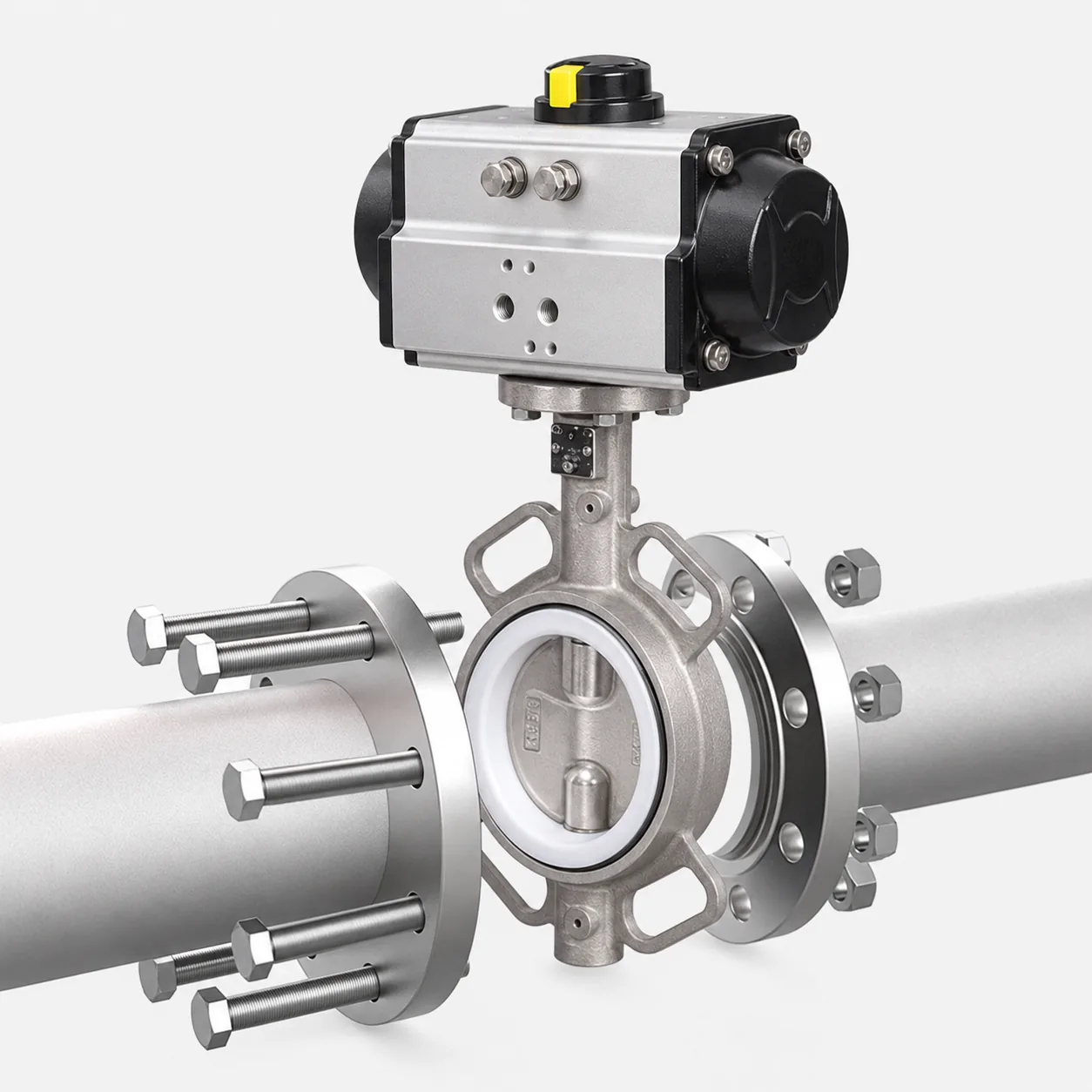
A stainless steel butterfly valve is one whose datasheet names a stainless grade for one or more of its body, disc, stem and seat parts, and the phrase alone does not say which. Valve Magazine describes the basic configuration of most butterfly valves as a body, stem, disc, seat and stem seal (Anderson & Ferner, 2022).
Readers still choosing the valve type can start with the ball valve vs butterfly valve comparison.
Published data shows four common builds, each with a different set of stainless parts.
| Build | Stainless parts | Other parts | Where it appears in published data | What the datasheet must say |
|---|---|---|---|---|
| Stainless disc and stem, iron body, resilient liner | disc and stem | cast or ductile iron body; elastomer seat | Bray's Series 20/21 options (Bray International, n.d.-b); NIBCO's figure-number key (NIBCO, n.d.) | body material; disc and stem grades |
| Iron body and disc, stainless seat ring and shaft | Type 316 body seat ring; ASTM A276 Type 304 or ASTM A564 Type 630, H1150 shafts | iron body; ductile iron disc | Val-Matic Bulletin 2000 (Val-Matic Valve and Manufacturing Corp., n.d.-b) | seat ring and shaft grades |
| All-stainless body, disc and stem, resilient seat | body, disc and stem | elastomer or PTFE-lined seat | Bray's 316 stainless steel body option (Bray International, n.d.-b) | body, disc and stem grades; seat compound |
| All-stainless offset design, seat in the body | body with its seat, disc and stem | metal or polymer seal ring | triple-offset valves, seat bolted in or integral to the body (Anderson & Ferner, 2022) | seat and seal-ring materials |
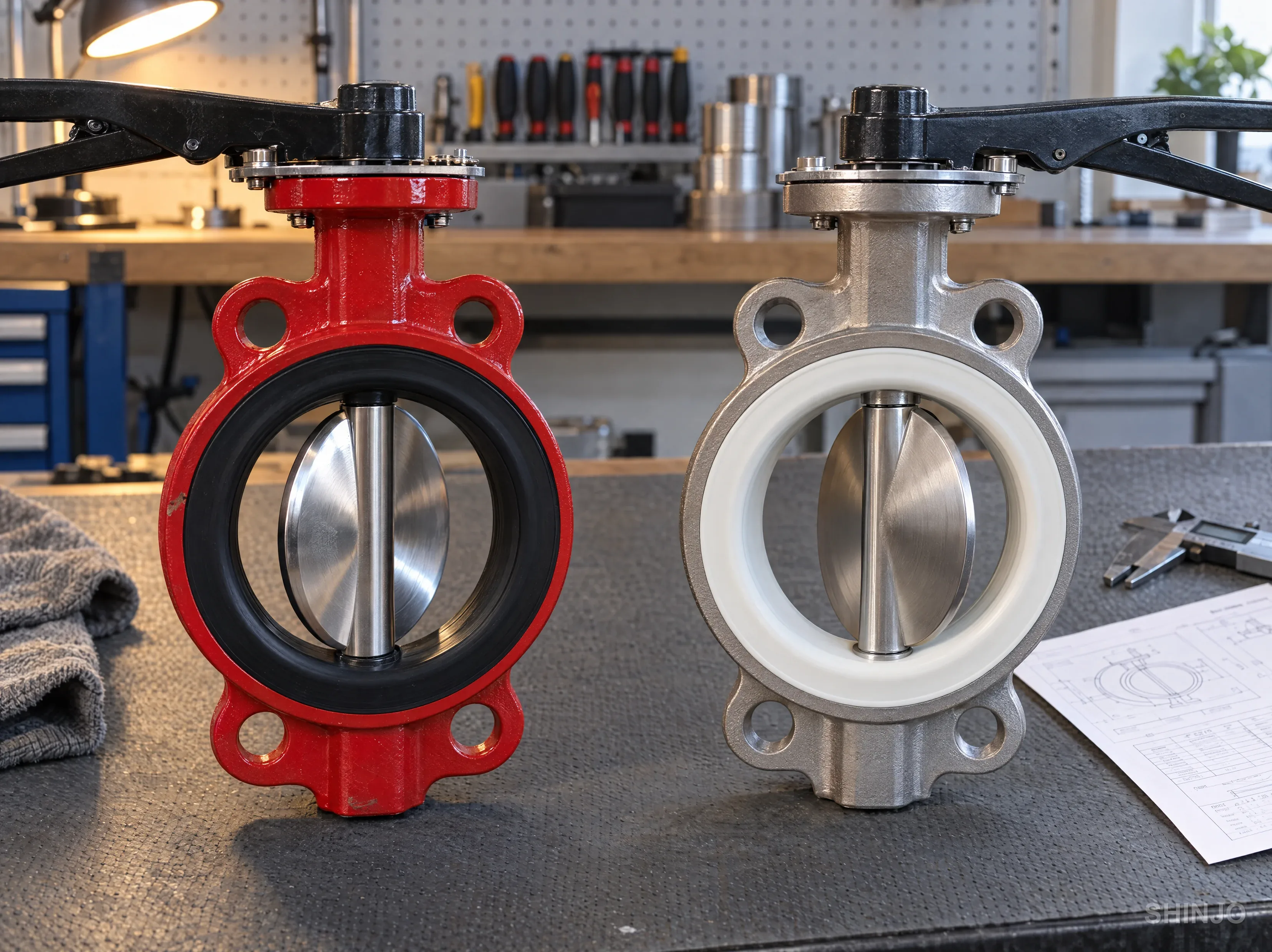
Bray's brochure B-1050 states that its seat design and internal disc-to-stem connection isolate the line media from the body and stem (Bray International, n.d.-a). On a lined, resilient-seated stainless butterfly valve, the fluid touches the seat and the disc; the body grade buys strength and external corrosion resistance, while the disc and seat decide internal corrosion life. In double- and triple-offset designs the seat sits in or on the body, so the body is wetted. The datasheet lists the wetted parts by grade.
Shinjo supplies butterfly valves; Shinjo's butterfly valve category page lists the current range, and the grade of each part still belongs on the datasheet.
On a butterfly valve datasheet, "stainless" can name the trim in an iron body or an all-stainless build. Body, disc, stem and seat are each specified by grade, drawing on options such as cast iron, ductile iron or 316 stainless bodies against 316 stainless or Hastelloy C-22 discs and stems (Bray International, n.d.-b).
Body and disc grade follow the medium, and the stem is chosen for strength first, because it carries the operating torque. A stainless steel butterfly valve pairs body and disc with the fluid, stem with seal and torque, and seat with the mating surface.
Emerson's reproduction of ASME B16.34 lists ASTM A351 CF8, CF3, CF8M and CF3M as cast valve materials (Emerson Automation Solutions, n.d.-a). In ASTM A351, CF8 and CF8M are the cast grades that correspond to 304 and 316, and CF3 and CF3M are their low-carbon versions. See the stainless steel grades comparison chart (ASTM, DIN, JIS, UNS) for cross-standard equivalents.
| Part | Stainless options in published data | What drives the choice | Datasheet line |
|---|---|---|---|
| Body | CF8, CF8M, CF3M (Emerson Automation Solutions, n.d.-a); iron with a liner | wetted medium; outside environment | ASTM A351 grade; wetted or lined |
| Disc | CF8M or 316 (NIBCO, n.d.); duplex, super duplex; molded over or encapsulated (Bray International, n.d.-a) | medium; chloride content | disc grade; coating |
| Stem or shaft | 316; ASTM A564 Type 630, H1150 (17-4 PH) (Val-Matic Valve and Manufacturing Corp., n.d.-b); 416 (NIBCO, n.d.) | strength, then corrosion | stem grade; heat-treatment condition |
| Seat ring (metal-seated) | hard-faced 316, Stellite, duplex (Anderson & Ferner, 2022) | galling and wear | seat materials; hardfacing |
Per Val-Matic's Engineering Manual, "17-4 PH SS is similar to 304 SS except it is capable of being precipitation hardened (PH) using heat treatment, doubling its strength and making it a good choice for high performance valve trim. 17-4 PH withstands corrosive attack better than any of the 400 series stainless steels and in most conditions its corrosion resistance closely approaches that of 300 series stainless steel. 17-4 PH is primarily used as a stem material for high pressure butterfly and ball valves" (Val-Matic Valve and Manufacturing Corp., n.d.-a).
Val-Matic Bulletin 2000 lists shafts as ASTM A276 Type 304 or ASTM A564 Type 630, H1150 (Val-Matic Valve and Manufacturing Corp., n.d.-b). NIBCO's alloy table records 17-4PH as ASTM A 564 630, UNS S17400, so Type 630 is 17-4 PH (NIBCO, n.d.). NIBCO's figure-number key offers stems in 416SS, 17-4PH or 316SS (NIBCO, n.d.); 410 and 416 are martensitic 400-series grades (NIBCO, n.d.). Strength and wear resistance from 17-4 PH or 416; corrosion resistance from 316, matching the wetted 300-series parts. The heat-treatment condition goes on the datasheet.
A butterfly valve stem carries the operating torque, so strength drives the grade. Val-Matic reports precipitation hardening doubles 17-4 PH's strength and names it a primary stem material for high-pressure butterfly and ball valves (Val-Matic Valve and Manufacturing Corp., n.d.-a). The heat-treatment condition, such as H1150, goes on the datasheet (Val-Matic Valve and Manufacturing Corp., n.d.-b).
The British Stainless Steel Association (BSSA) writes that crevice corrosion should be rare below 200 ppm (mg/L) chloride for 304 types and below 1,000 ppm for 316 types, in waters (British Stainless Steel Association, n.d.). The Australian Stainless Steel Development Association (ASSDA) reports grade 316 offers a solution to around 90% of marine applications (Australian Stainless Steel Development Association, n.d.). The three most common marine duplex types are UNS S32304 (2304), UNS S31803 (2205) and UNS S32750 (2507) (Australian Stainless Steel Development Association, n.d.). S31803 has yield strength twice that of 304 or 316, with much higher resistance to pitting and crevice corrosion in seawater than 316 (Australian Stainless Steel Development Association, n.d.). Swagelok gives the pitting resistance equivalent number as PREN = %Cr + 3.3x(%Mo + %W) + 16x%N (Swagelok Company, n.d.). PREN ranks pitting resistance; it does not approve a grade for a service. Brine is chloride-bearing water above the BSSA threshold for 316, so duplex discs replace 316. See duplex stainless steel valves.
A stainless steel butterfly valve is offered in three industrial designs: concentric resilient-seated, double-offset high-performance and triple-offset metal-seated. The design decides the shutoff, the temperature envelope and whether the valve is rated by cold working pressure (CWP) or by ASME Class.
The API 609 monogram licensing form names two product classes, Category A and Category B (American Petroleum Institute, 2023). Category A covers valves rated by the manufacturer's CWP, usually of concentric design; Category B is ASME Class and pressure-temperature rated, with an offset seat and an eccentric or concentric disc (American Petroleum Institute, 2023). EN 593 is the European standard for general-purpose metallic butterfly valves. Bray names MSS SP-67 and API 609 Category A as its Series 20/21 design standards (Bray International, n.d.-b). The datasheet names the standard, category and edition; the buyer confirms it with the publisher.
| Design | How disc and seat meet | Common seats | Rating basis | Published temperature envelope |
|---|---|---|---|---|
| Concentric resilient-seated | position seated, continuous disc-to-seat interference (Anderson & Ferner, 2022) | EPDM, Buna-N, PTFE, natural rubber (Anderson & Ferner, 2022) | CWP, between ASME Class 125 and Class 150 flanges (Anderson & Ferner, 2022); API 609 Category A (American Petroleum Institute, 2023) | set by the seat compound |
| Double offset | camming action lifts the disc away from the seat (Anderson & Ferner, 2022) | PTFE, reinforced PTFE, TFM, UHMWPE, Inconel (Anderson & Ferner, 2022) | ASME Class; API 609 Category B (American Petroleum Institute, 2023) | polymer seats per compound; metal-seated up to 482 °C (900 °F) in dirty service (Anderson & Ferner, 2022) |
| Triple offset | seal ring meets a conical seat only in the final degree of closing; torque-seated (Anderson & Ferner, 2022) | hard-faced 316, nickel aluminum bronze, Stellite, duplex (Anderson & Ferner, 2022) | Class 150 up to Class 1500 (Anderson & Ferner, 2022) | -196 °C to 816 °C (-320 °F to 1,500 °F) in varying configurations (Anderson & Ferner, 2022) |
Emerson's Vanessa Series 30,000 brochure lists Stellite grade 21 seats and a duplex resilient seal ring as a minimum, and says Stellite 21 coats the body seat (Emerson Automation Solutions, n.d.-b). The brochure's series range is -254 °C to 815 °C (-425 °F to 1500 °F) (Emerson Automation Solutions, n.d.-b). A series envelope is not the ordered configuration's envelope, so the datasheet names the configuration.
A history of the triple-offset butterfly valve is published by Shinjo. Shinjo supplies offset designs as well; Shinjo's flanged triple-eccentric butterfly valve page and Shinjo's metal-seated wafer butterfly valve page show two of them, and the category, class and seat still belong on the datasheet.
ASME B16.34 Class 150 working pressure, bar (psi), as printed in Emerson's reproduction of the tables (Emerson Automation Solutions, n.d.-a).
| Material | -29 to 38 °C (-20 to 100 °F) | 100 °C (212 °F) | 150 °C (302 °F) | 200 °C (392 °F) |
|---|---|---|---|---|
| WCB | 19.6 (285) | 17.7 (257) | 15.8 (229) | 13.8 (200) |
| CF8/CF3 | 19.0 (275) | 15.7 (228) | 14.2 (206) | 13.2 (191) |
| CF8M/CF3M | 19.0 (275) | 16.2 (235) | 14.8 (215) | 13.7 (199) |
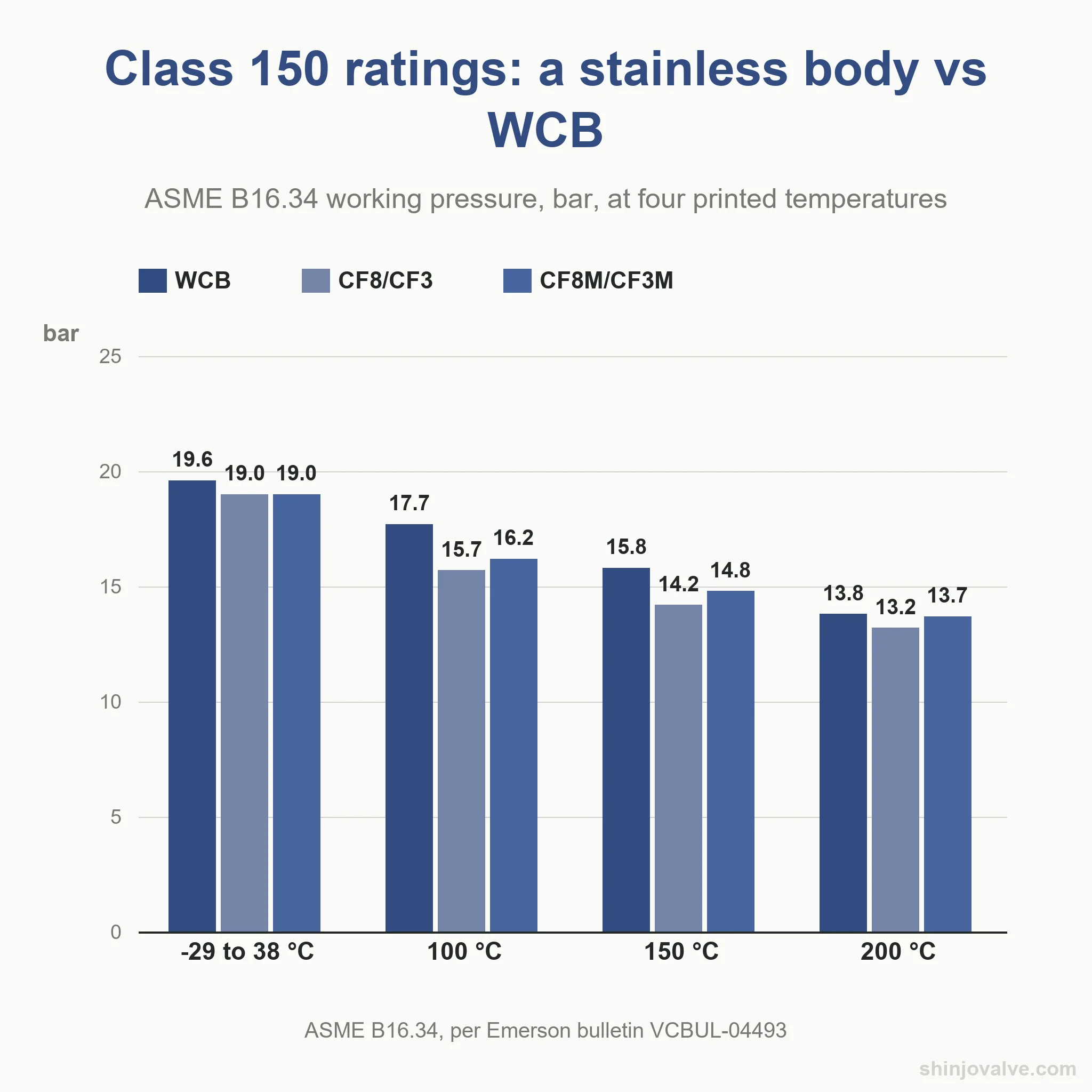
At -29 to 38 °C (-20 to 100 °F), Class 300 rates WCB 51.1 bar (740 psi) and CF8M/CF3M 49.6 bar (720 psi) (Emerson Automation Solutions, n.d.-a). ASME B16.34 places WCB in material group 1.1, CF8/CF3 in 2.1 and CF8M/CF3M in 2.2 (Emerson Automation Solutions, n.d.-a). The bulletin adds that its tables apply within the ASME standard, and a valve under the ASME Boiler and Pressure Vessel Code, the ASME code for pressure piping or government regulation is subject to that code's limits (Emerson Automation Solutions, n.d.-a).
A stainless body does not raise the class rating. At ambient it sits slightly below WCB, and the gap widens at 100 °C (212 °F). Category A is CWP-rated, so these tables govern a Class-rated body.
A stainless body does not lift the ASME B16.34 class rating. At -29 to 38 °C (-20 to 100 °F), a Class 150 CF8M/CF3M body rates 19.0 bar (275 psi) against WCB's 19.6 bar (285 psi); at 100 °C (212 °F) it rates 16.2 bar (235 psi) against 17.7 bar (257 psi) (Emerson Automation Solutions, n.d.-a).
A butterfly valve labeled ‘stainless’ still leaves the body, disc, stem and seat to specify one by one, each against the line’s chlorides, temperature and pressure class before a design or seat compound gets chosen. Shinjo’s butterfly valve category lists the current range across concentric, double-offset and triple-offset designs, wafer through double-flanged, for procurement teams working from a finished set of those grades.
In most stainless butterfly valves the seat or liner sets the temperature limit; the body's ASME B16.34 rating continues past it. A Class 150 CF8M/CF3M body rates 16.2 bar (235 psi) at 100 °C (212 °F) and 13.7 bar (199 psi) at 200 °C (392 °F) (Emerson Automation Solutions, n.d.-a), while Bray's BUNA-N reaches 100 °C (212 °F) and its peroxide-cured EPDM 121 °C (250 °F) (Bray International, n.d.-a).
Bray rates peroxide-cured EPDM from -29 °C to 121 °C (-20 °F to 250 °F) and FKM from -18 °C to 204 °C (0 °F to 400 °F) (Bray International, n.d.-a). Its Series 20/21 product page publishes -29 °C to 204 °C (-20 °F to 400 °F) as the valve's range, across EPDM, BUNA-N, PTFE-lined EPDM, FKM and polyurethane seats: the envelope, not the range of any one seat (Bray International, n.d.-b). Watts rates its EPDM-seated ES-W7000 sanitary valve at 10 bar (145 psi) from -20 °C to 135 °C (-4 °F to 275 °F), a second maker's EPDM at a different figure (Watts Water Technologies, n.d.). A range belongs to a compound and a datasheet, not to an elastomer name.
Bray rates PTFE-lined EPDM from -29 °C to 121 °C (-20 °F to 250 °F) and virgin PTFE from -18 °C to 204 °C (0 °F to 400 °F) (Bray International, n.d.-a). Val-Matic defines RPTFE as PTFE with a percentage of fiberglass or filler for strength, stability and resistance to abrasive wear, cold flow and permeation in molded seats (Val-Matic Valve and Manufacturing Corp., n.d.-a). Val-Matic gives RPTFE a range of -196 °C to 232 °C (-320 °F to 450 °F) (Val-Matic Valve and Manufacturing Corp., n.d.-a). Val-Matic cautions that RPTFE should not be used in applications that attack glass, such as hydrofluoric acid and hot or strong caustics (Val-Matic Valve and Manufacturing Corp., n.d.-a).
Valve Magazine gives a metal-seated double-offset valve a limit up to 482 °C (900 °F) in dirty service (Anderson & Ferner, 2022). Triple-offset designs span -196 °C to 816 °C (-320 °F to 1,500 °F) in varying configurations (Anderson & Ferner, 2022). An overview of valve seat and seat ring materials covers metal, resilient and PTFE families together.
| Seat or liner | Temperature range | Source | Where it is used |
|---|---|---|---|
| Peroxide-cured EPDM | -29 °C to 121 °C (-20 °F to 250 °F) (Bray International, n.d.-a) | Bray B-1050 | Bray's standard seat |
| HTEPDM | -29 °C to 150 °C (-20 °F to 300 °F) (Bray International, n.d.-a) | Bray B-1050 | hot water |
| BUNA-N (NBR) | -18 °C to 100 °C (0 °F to 212 °F) (Bray International, n.d.-a) | Bray B-1050 | hydrocarbon service |
| FKM | -18 °C to 204 °C (0 °F to 400 °F) (Bray International, n.d.-a) | Bray B-1050 | acid, oil, heat |
| Neoprene | -18 °C to 82 °C (0 °F to 180 °F) (Bray International, n.d.-a) | Bray B-1050 | refrigerants; paper lines |
| UHMWPE | -18 °C to 85 °C (0 °F to 185 °F) (Bray International, n.d.-a) | Bray B-1050 | abrasive chemicals |
| PTFE-lined EPDM | -29 °C to 121 °C (-20 °F to 250 °F) (Bray International, n.d.-a) | Bray B-1050 | corrosive services |
| Virgin PTFE | -18 °C to 204 °C (0 °F to 400 °F) (Bray International, n.d.-a) | Bray B-1050 | chemical service |
| EPDM in a sanitary valve | -20 °C to 135 °C (-4 °F to 275 °F), the valve's rating (Watts Water Technologies, n.d.) | Watts ES-W7000 | sanitary valve |
| RPTFE | -196 °C to 232 °C (-320 °F to 450 °F) (Val-Matic Valve and Manufacturing Corp., n.d.-a) | Val-Matic | molded seats |
| Metal, double offset | up to 482 °C (900 °F) (Anderson & Ferner, 2022) | Valve Magazine | dirty service |
| Metal, triple offset | -196 °C to 816 °C (-320 °F to 1,500 °F) (Anderson & Ferner, 2022) | Valve Magazine | varying configurations |
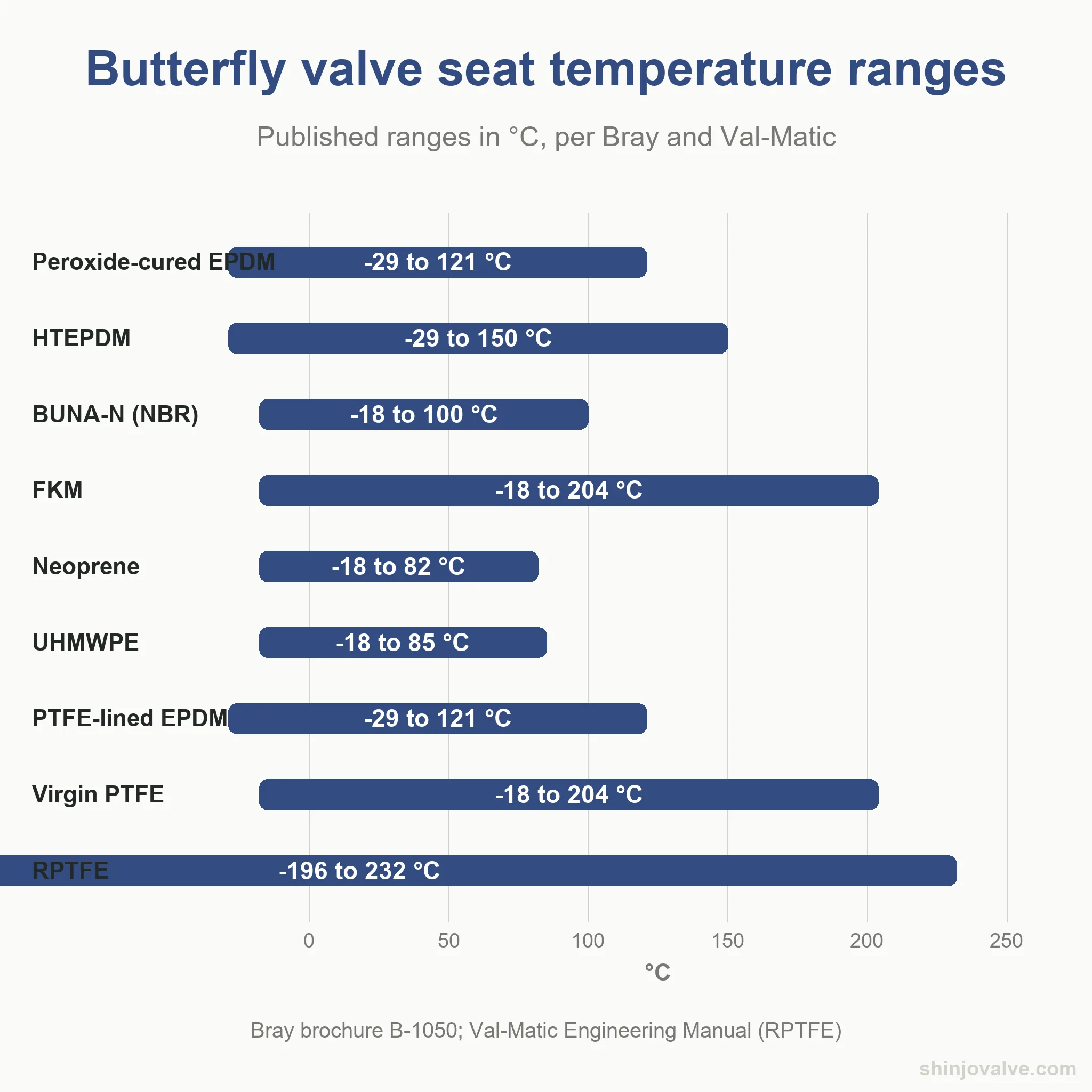
Bray's peroxide-cured EPDM seat stops at 121 °C (250 °F) (Bray International, n.d.-a), while ASME B16.34 still rates a Class 150 CF8M/CF3M body at 13.7 bar (199 psi) at 200 °C (392 °F) (Emerson Automation Solutions, n.d.-a). The seat's published range, on the valve maker's datasheet, is the temperature line to specify, not the body's ASME rating.
Bray describes BUNA-N as a general purpose seat material particularly suitable for hydrocarbon service (Bray International, n.d.-a). Bray notes that FKM has improved acid, oil and temperature resistance over other seat materials (Bray International, n.d.-a). Val-Matic writes that EPDM has strong resistance to ozone, certain hydraulic fluids, brake fluids, steam and water (Val-Matic Valve and Manufacturing Corp., n.d.-a). NIBCO cautions against installing an EPDM liner in compressed air lines (NIBCO, n.d.). Val-Matic's Engineering Manual carries a chemical resistance guide that rates elastomers, plastics and metals chemical by chemical, and calls it a guide only (Val-Matic Valve and Manufacturing Corp., n.d.-a).
Work through three steps:
- Name the medium, its concentration and the temperature range.
- Check each wetted material (seat and disc, with stem if wetted) against the valve maker's chemical resistance guide.
- Get the supplier's seat recommendation in writing. Bray notes that seat availability depends on valve size and series, and that the pressure and temperature of service also affect seat life and performance (Bray International, n.d.-a).
A sanitary stainless butterfly valve differs from an industrial one in its ends, its internal finish, its seat compound and its cleanable design, and a named framework or federal regulation sets each of those. The datasheet lists them one by one rather than calling the valve "food grade" without evidence.
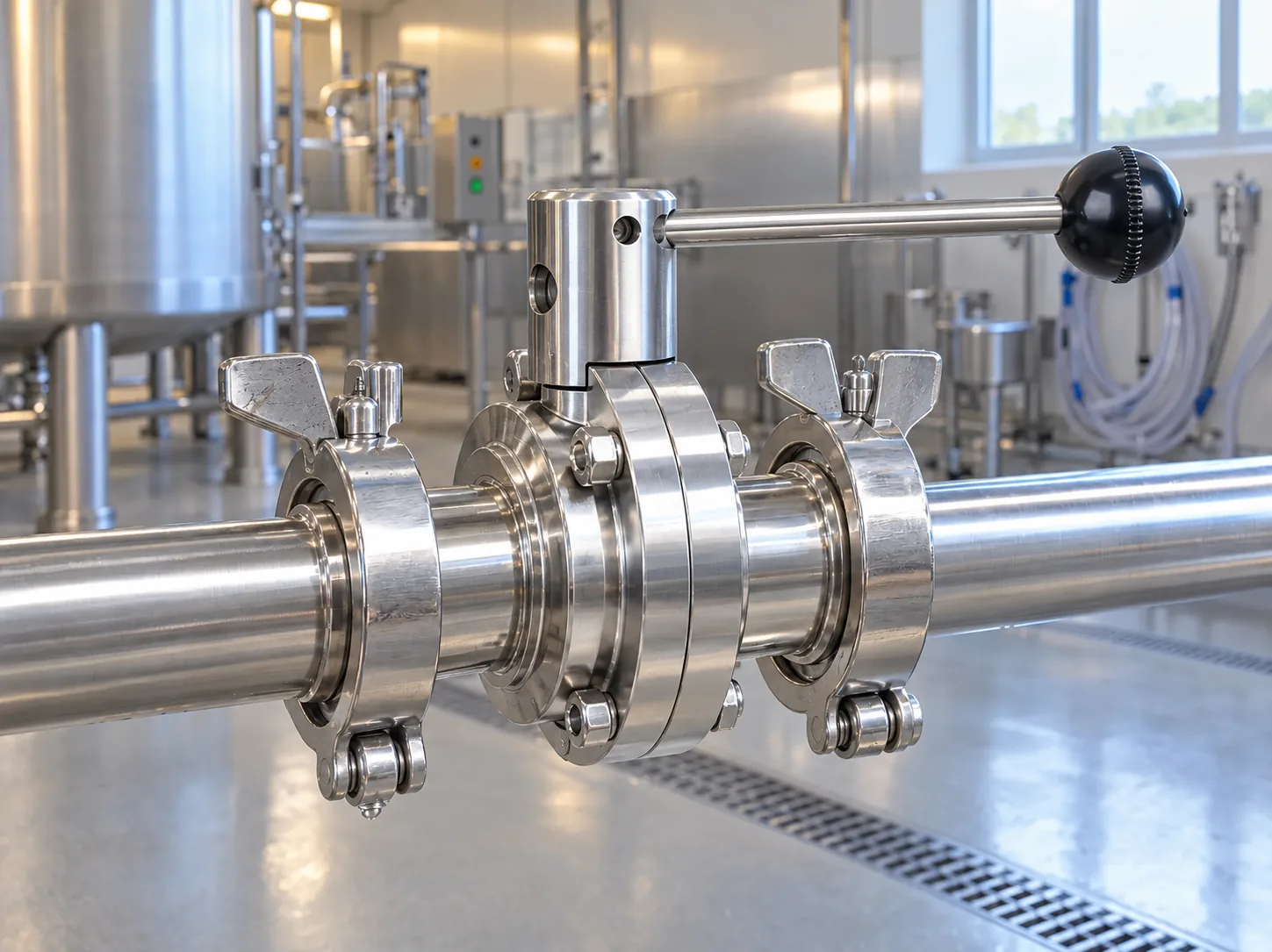
Watts' Series W7000 two-piece sanitary butterfly valve uses a 316L stainless steel body and disc, an EPDM seat, and tri-clamp or tube-weld ends in NPS 1/2 to 4 (DN 15 to 100) (Watts Water Technologies, n.d.). It is rated 10 bar (145 psi) from -20 °C to 135 °C (-4 °F to 275 °F) (Watts Water Technologies, n.d.). Watts' datasheet lists a hygienic design compliant with 3-A standards, with end connections in accordance with the 3-A standard (Watts Water Technologies, n.d.), and prints "32 Ra internal surface finish" with no unit (Watts Water Technologies, n.d.). Because no unit is printed, the buyer asks for the unit and the measuring method rather than assuming one.
Rubber articles intended for repeated use may be safely used in producing, manufacturing, packing, processing, preparing, treating, packaging, transporting or holding food, subject to the provisions of the section (Code of Federal Regulations, n.d.). They are prepared from the natural and synthetic polymers and adjuvant substances the section lists, and that list includes acrylonitrile-butadiene copolymer, ethylene-propylene copolymer elastomers, chloroprene polymers, natural rubber and silicone elastomers (Code of Federal Regulations, n.d.). The food-contact surface, extracted with distilled water at reflux temperature (the boiling temperature of the extracting liquid), shall yield total extractives not to exceed 20 milligrams per square inch during the first 7 hours of extraction, nor 1 milligram per square inch during the succeeding 2 hours (Code of Federal Regulations, n.d.). For fatty food extracted with n-hexane at reflux, the limits are 175 milligrams per square inch during the first 7 hours and 4 milligrams per square inch during the succeeding 2 hours (Code of Federal Regulations, n.d.). Finished rubber articles are thoroughly cleansed before their first use in contact with food (Code of Federal Regulations, n.d.). Compliance belongs to the seat compound, not to the stainless body, so the datasheet names the compound and asks for the supplier's statement of compliance.
21 CFR 177.2600 permits rubber articles for repeated food contact if they are made from the polymers and adjuvants it lists, holds the food-contact surface to the aqueous and fatty extraction limits, and requires them to be cleansed before first use (Code of Federal Regulations, n.d.).
3-A Sanitary Standards, Inc. publishes sanitary design standards for dairy and food processing equipment. EHEDG, the European Hygienic Engineering and Design Group, publishes hygienic design guidelines and certifies cleanable design. ASME BPE is ASME's Bioprocessing Equipment standard for equipment in bioprocessing and pharmaceutical service. The purchase order names which framework applies and what evidence the supplier provides.
Note: A "food grade" seat in an industrial wafer body does not make a sanitary valve: the ends, the internal finish and a cleanable design belong to the sanitary class too.
Choose the body style from how the valve leaves the line and whether it must hold pressure at a dead end; then set the flange, face-to-face and top-flange standards. Flange drilling follows ASME B16.1, ASME B16.5 or EN 1092; face-to-face follows ISO 5752 (EN 558); actuator mounting follows ISO 5211.
| Body style | How it installs | Dead-end service | Datasheet line |
|---|---|---|---|
| Wafer | clamped between two pipe flanges (Val-Matic Valve and Manufacturing Corp., n.d.-a) | "cannot be used for dead-end service" (Val-Matic Valve and Manufacturing Corp., n.d.-a) | body style and flange standard |
| Lug | bolted to one or both flanges through threaded lugs (Val-Matic Valve and Manufacturing Corp., n.d.-a) | possible, depending on seat design, but may be de-rated (Val-Matic Valve and Manufacturing Corp., n.d.-a) | dead-end rating in writing |
| Double-flanged | flanges on both ends, bolted to the pipe flanges (Val-Matic Valve and Manufacturing Corp., n.d.-a) | possible; some valve types may be de-rated (Val-Matic Valve and Manufacturing Corp., n.d.-a) | dead-end rating in writing |
| Butt-weld | ends beveled and welded into the line (Val-Matic Valve and Manufacturing Corp., n.d.-a) | not addressed by the source; ask the maker | weld end preparation |
Bray's Series 20/21 page lists ASME B16.1 Class 125, ASME B16.5 Class 150 and EN 1092 PN 10 (Bray International, n.d.-b). NIBCO's PDH course M180 rules out Class 250 cast iron and Class 300 steel flanges on its wafer and lug line, and forbids welding the pipe once the valve is bolted to the flanges (NIBCO, n.d.). Match the flange drilling to the pipe flanges.
Shinjo supplies wafer and lug valves: Shinjo's lug and wafer butterfly valve page, its lever-operated wafer butterfly valves and its high-pressure wafer butterfly valves are examples; confirm the flange drilling and dead-end rating on each datasheet.
Bray's brochure B-1050 rates a resilient-seated valve, metal disc and stem, at 10.3 bar (150 psi) bidirectional bubble-tight shutoff, NPS 1 to 20 (DN 25 to 500), with downstream flanges; without them, and with lug bodies and disc closed, that table drops to 5.2 bar (75 psi) at NPS 2 to 12 (DN 50 to 300) and 3.4 bar (50 psi) at NPS 14 to 20 (DN 350 to 500) (Bray International, n.d.-a). Watts' ES-W7000 by contrast rates its sanitary valve for dead-end service up to the valve's full pressure rating (Watts Water Technologies, n.d.). Ask for the dead-end rating in writing.
A wafer valve cannot serve dead-end; a lug valve can but may be de-rated (Val-Matic Valve and Manufacturing Corp., n.d.-a). Bray's brochure B-1050 rates its lug bodies at 5.2 bar (75 psi) at NPS 2 to 12 (DN 50 to 300) and 3.4 bar (50 psi) at NPS 14 to 20 (DN 350 to 500) dead-end, against 10.3 bar (150 psi) with downstream flanges (Bray International, n.d.-a). Get it in writing.
ISO 5211 is the ISO standard for part-turn actuator attachment to industrial valves. Bray's double-flanged Series 3A/3AH pairs ISO 5752 (EN 558) face-to-face with ISO 5211 mounting flanges, so one design serves many markets (Bray International, n.d.-b). A resilient-seated valve is position seated with continuous disc-to-seat interference; a triple-offset valve is torque-seated (Anderson & Ferner, 2022). For low-pressure 3.4 bar (50 psi) service, Bray's B-1050 uses a reduced disc diameter to lower seating torque and extend seat life (Bray International, n.d.-a). Val-Matic's Engineering Manual pairs traveling-nut actuators with the high seating torque of butterfly and ball valves (Val-Matic Valve and Manufacturing Corp., n.d.-a). Seat interference and torque seating shape the torque profile; size the actuator to the valve maker's published torque for the seat and service. Valve Magazine names manual (lever or wheel), electric, rack-and-pinion pneumatic and scotch yoke actuators (Anderson & Ferner, 2022). Resilient-seated stem sealing has a primary seal (seat flat to disc hub), a secondary seal (stem diameter larger than a hole in seat) and a tertiary upper stem seal (Anderson & Ferner, 2022). Shinjo's torque chart for triple-eccentric metal-seated butterfly valves shows the format such data takes.
The purchase order names one shell test and one seat test standard, the acceptance the seat test must meet, and the edition. A catalog's shutoff wording, such as "bubble-tight" or "zero leakage," is a claim, not an acceptance; it names no standard the tester can measure against.
A shell test pressurizes the assembled body to show it holds pressure; a seat or closure test pressurizes the closed disc against a stated acceptance. Four documents apply: API 598, "Valve Inspection and Testing"; ISO 5208, the pressure-testing standard for metallic industrial valves; EN 12266-1, the European standard for pressure tests on metallic industrial valves; and MSS SP-61, "Pressure Testing of Valves". Makers cite these standards. Bray's Series 20/21 lists MSS SP-61, API 598 and EN 12266-1 as its testing standards (Bray International, n.d.-b). Watts states that the W7000 is "inspected and tested in accordance with API 598" (Watts Water Technologies, n.d.). The purchase order names the standard and edition; the buyer confirms the current edition with the publisher.
A seat test proves that the closed disc seals to the acceptance the named standard and edition set, under that standard's test medium. A catalog word such as "bubble-tight" or "zero leakage" does not replace the standard and its acceptance.
Emerson's Vanessa Series 30,000 brochure prints a footnote: "Zero leakage means no visible leakage when tested at high pressure with water and low pressure with air according to existing international standards" (Emerson Automation Solutions, n.d.-b). Bray's Series 20/21 page gives a shutoff rating of "Bidirectional Bubble-tight" (Bray International, n.d.-b). A shutoff claim becomes a specification only when it names a test standard and an acceptance the tester can measure.
Note: Ask which standard, which test medium and which acceptance produced any "zero leakage" or "bubble-tight" line.
A stainless build does not prevent three failure modes in a butterfly valve: chloride pitting and crevice corrosion, galling where stainless slides on stainless, and permeation or cold flow of polymer seats. Each has a datasheet line that designs it out.
Per Swagelok, pitting begins with breakdown of stainless steel's protective chromium-rich oxide layer (Swagelok Company, n.d.). Crevice corrosion begins the same way but hides inside crevices (Swagelok Company, n.d.). The British Stainless Steel Association (BSSA) states crevice corrosion should be rare below 200 ppm (mg/L) chloride for 304 types, below 1,000 ppm for 316 types, in waters (British Stainless Steel Association, n.d.). BSSA states sodium hypochlorite, the main constituent of household bleach at around 5.25%, can cause pitting or crevice corrosion on most stainless steel grades (British Stainless Steel Association, n.d.). A butterfly valve has crevices under the seat or liner edge, at the disc-to-stem joint, at flange faces. Peer-reviewed research examines pitting of stainless steel in chloride and bromide solutions (Kaneko & Isaacs, 2000).
Val-Matic defines galling as the tearing of metal surfaces that rub together, from lack of lubrication or extreme contact pressure between materials of similar hardness (Val-Matic Valve and Manufacturing Corp., n.d.-a). NIBCO describes Stellite as very resistant to heat, abrasion, corrosion, impact, galling, oxidation, thermal shock and erosion (NIBCO, n.d.). Emerson's Vanessa triple-offset valve pairs a Stellite 21 body-seat overlay with a duplex seal ring (Emerson Automation Solutions, n.d.-b).
Galling tears metal surfaces that rub together, from lack of lubrication or extreme contact pressure between materials of similar hardness (Val-Matic Valve and Manufacturing Corp., n.d.-a). Stainless metal-seated butterfly valves answer it with dissimilar or hard-faced seating, such as a Stellite 21 overlay against a duplex seal ring (Emerson Automation Solutions, n.d.-b).
Val-Matic's Engineering Manual states that PTFE reinforced with fiberglass or filler resists cold flow and permeation in molded seats (Val-Matic Valve and Manufacturing Corp., n.d.-a). Bray describes its sintered PTFE as offering low permeability (Bray International, n.d.-a). Bray's conductive PTFE seat and disc have a minimum 3 mm (1/8 in) thickness against permeation, specific to that product (Bray International, n.d.-a). Bray's on/off velocity limits are 9 m/s (30 ft/s) for fluids and 54 m/s (175 ft/s) for gases, protecting the seat (Bray International, n.d.-a).
| Failure mode | Where it starts | Datasheet line |
|---|---|---|
| Chloride pitting and crevice corrosion | crevices under seat/liner edge, disc-to-stem, flange faces | grade checked against BSSA thresholds (British Stainless Steel Association, n.d.) |
| Galling | metal seating faces under contact pressure | dissimilar or hard-faced seats (Emerson Automation Solutions, n.d.-b) |
| Liner permeation and cold flow | PTFE seats and liners | reinforced PTFE where cold flow is a risk (Val-Matic Valve and Manufacturing Corp., n.d.-a) |
| Seat damage from velocity | seat in on/off service | Bray's 9 m/s (30 ft/s) for fluids (Bray International, n.d.-a) |
A quotation for a stainless steel butterfly valve is only as exact as the datasheet lines sent with it.
- Service line: medium, concentration, chlorides, solids, temperature, design pressure, throttling or on-off, flow direction, end-of-line.
- Size stated as NPS with DN.
- Rating basis as CWP, ASME Class or PN.
- Design standard: API 609 category, EN 593 or MSS SP-67.
- Body grade naming ASTM A351 CF8, CF8M or CF3M, or duplex; wetted or not.
- Disc grade and any coating or encapsulation.
- Stem grade with heat-treatment condition, for example ASTM A564 Type 630 H1150.
- Seat or liner compound with rated temperature range from the datasheet; metal seats give seal-ring materials and hardfacing.
- Body style, flange drilling, face-to-face standard, and the dead-end rating in writing.
- ISO 5211 top flange and operator (lever, gear, pneumatic or electric), actuator sized to the maker's published torque.
- Shell and seat test standard, acceptance and edition (API 598, ISO 5208 or EN 12266-1).
- Sanitary service: 316L wetted parts, clamp or weld ends, internal Ra with unit, seat complying with 21 CFR 177.2600, framework (3-A, EHEDG or ASME BPE) with evidence.
- Material certificates for each wetted part.
A stainless steel butterfly valve datasheet fixes the service, each wetted part's grade, the design with its API 609 category and rating basis, the seat's rated range, body style with dead-end rating, the top flange and actuator, and the test standard and acceptance. Sanitary orders name the framework.
Body, disc and stem grades move price and delivery. So do seat type (resilient, polymer or metal) and hardfacing, the design (concentric, double offset or triple offset), size and class, actuation, sanitary finish, and the test and documentation scope.
A request carrying these lines matches against Shinjo's butterfly valve range, so the reply names what Shinjo supplies for the specified service instead of asking the same questions back.
By construction, the valve is either stainless-trimmed (a stainless disc, stem or seat ring in an iron body) or all-stainless (body, disc and stem in stainless). By service class, it is industrial (wafer, lug or flanged; concentric or offset) or sanitary (316L, clamp or weld ends, and a seat compound complying with 21 CFR 177.2600).
Four appear across specifications. The seat sets the temperature limit: per Bray, peroxide-cured EPDM runs -29 °C to 121 °C (-20 °F to 250 °F). Resilient-seated valves are often rated by CWP, below ASME class ratings. A wafer body cannot serve dead-end. 304 or 316 parts can pit or crevice-corrode in chlorides.
No single figure applies. The seat is usually the part that wears, and per Bray, "the pressure and temperature of service also affect seat life and performance." In triple-offset valves, Valve Magazine notes that the seal ring can be laminated metal and graphite or a solid metal sheet, both field replaceable.
The best stainless steel butterfly valve for a given line is the one whose datasheet matches the service. Confirm the body, disc and stem grades against the medium; confirm the seat compound and its published temperature range; confirm the design category (concentric, double-offset or triple-offset); and confirm the test standard the purchase order names.
Only when it is built as a sanitary valve. That means 316L wetted parts, tri-clamp or tube-weld ends, a stated internal finish, a seat compound complying with 21 CFR 177.2600, and a named framework such as 3-A. An industrial wafer or lug valve with a 316 disc does not qualify.
Strength first. Per Val-Matic's Engineering Manual, 17-4 PH is precipitation hardened, "doubling its strength", and is "primarily used as a stem material for high pressure butterfly and ball valves." A 316 stem, by contrast, is chosen when the priority is corrosion resistance that matches the wetted parts.
When chloride exceeds what 316 can hold. Per BSSA, crevice corrosion should be rare below 1,000 ppm chloride in waters for 316 types. In seawater, ASSDA reports that 2205 has much higher resistance to pitting and crevice corrosion than 316; ASSDA lists 2304, 2205 and 2507 as the common marine duplex grades.
Per Bray, peroxide-cured EPDM runs -29 °C to 121 °C (-20 °F to 250 °F), and virgin PTFE runs -18 °C to 204 °C (0 °F to 400 °F). Per Val-Matic, RPTFE runs -196 °C to 232 °C (-320 °F to 450 °F). Read the rating on the valve maker's own datasheet; other makers publish different ranges.
It is sold under the same name, so the datasheet must list each part by grade. Per Bray, in a lined resilient-seated valve the seat isolates the body from the fluid; the disc and the seat then decide internal corrosion life, and the iron body sees no line media.
A stainless steel butterfly valve is specified when the datasheet closes every decision the phrase leaves open. Which parts of the valve are stainless, which parts touch the fluid, and the grade of each: body, disc, stem and seat named separately. The design and its rating basis: concentric, double-offset or triple-offset, rated to an ASME class or to a manufacturer's cold working pressure. The seat compound and the temperature limit it sets, with sanitary requirements added where the service asks for them. The body style, the flange drilling, the actuator interface and the stem sealing. The test standard and the acceptance the purchase order requires by name. And the lines that design out chloride pitting, disc-seat galling and liner permeation before the valve is built.
Where a resilient liner isolates the body from the flow, the disc, stem and seat carry the corrosion decision instead. Read together, those datasheet lines describe one valve.
- Bray International. (n.d.-a). Resilient seated butterfly valves (Brochure B-1050). https://www.bray.com/docs/default-source/brochures/product-brochures/en_b-1050_rsb_valves_web.pdf
- Bray International. (n.d.-b). Series 20/21 resilient seated butterfly valve. https://www.bray.com/valves-actuators-controls/butterfly-valves/resilient-seated/series-20-21-resilient-seated-butterfly-valve
- Emerson Automation Solutions. (n.d.-a). Pressure/temperature ratings ASME B16.34 valves (Bulletin VCBUL-04493-EN). https://www.emerson.com/is/content/emerson/en/final-control/isolation-valves/bu-content/documents/ISV-BLT-Pressure-Temperature-Ratings-ASME-16.34-VCBUL-04493-EN.pdf
- Val-Matic Valve and Manufacturing Corp. (n.d.-a). Engineering manual. https://www.valmatic.com/Portals/0/pdfs/EngineeringManual.pdf
- Val-Matic Valve and Manufacturing Corp. (n.d.-b). Series 2000 AWWA butterfly valve (Bulletin 2000). https://www.valmatic.com/Portals/0/brochures/BFV_2000.pdf
- NIBCO. (n.d.). Specifying and the technical evaluation of butterfly valves (PDH course M180). https://pdhonline.com/courses/m180/Nibco%20Butterfly%20Valve.pdf
- Swagelok Company. (n.d.). Pitting corrosion vs. crevice corrosion: Identifying the differences. https://www.swagelok.com/en/blog/pitting-corrosion-crevice-corrosion-identifying-the-differences
- Anderson, M., & Ferner, H. (2022, January 11). An overview of butterfly valves. Valve Magazine. https://valvemagazine.com/articles/an-overview-of-butterfly-valves
- British Stainless Steel Association. (n.d.). Crevice corrosion. https://bssa.org.uk/bssa_articles/category-crevice-corrosion
- Australian Stainless Steel Development Association. (n.d.). Corrosion resistance in marine environments. https://www.assda.asn.au/component/content/article?id=170
- Code of Federal Regulations. (n.d.). Title 21, Chapter I, Part 177, Subpart C, Section 177.2600: Rubber articles intended for repeated use. https://www.ecfr.gov/current/title-21/chapter-I/subchapter-B/part-177/subpart-C/section-177.2600
- Emerson Automation Solutions. (n.d.-b). Vanessa Series 30,000 triple offset valve: Basic configuration (Brochure) [PDF]. Askalon. https://www.askalon.com/uploads/downloads/brochure_series_30_000_basic_con.pdf
- Watts Water Technologies. (n.d.). Series W7000 2-piece sanitary butterfly valves with tri-clamp and tube weld connections (ES-W7000). https://www.watts.com/dfsmedia/0533dbba17714b1ab581ab07a4cbb521/672249-source/639153956620000000/es-w7000-butterfly-valves.pdf
- American Petroleum Institute. (2023). API Monogram Program licensing information form: API Standard 609, Butterfly valves (FM-3100-609). https://www.api.org/-/media/files/certification/monogram-apiqr/0_api-monogram-apiqr/lifs/api_609_licensing_information_form_20230821.pdf
- Kaneko, M., & Isaacs, H. S. (2000). Pitting of stainless steel in bromide, chloride and bromide/chloride solutions. Corrosion Science, 42(1), 67-78. https://doi.org/10.1016/s0010-938x(99)00056-6
Last reviewed and updated: September 2026. Author: Shinjo Valve engineering team. For valve selection support or a quotation against your service conditions, contact our team.
